

A few years ago I was working on Arne Herløv Petersen's harrowing story about the spy case against him, The viewing process, and had taken the book with him on his trip.
I shouldn't have done that.
At Copenhagen Airport, in one of the cafes, surrounded by hundreds of people, I read the section about the CIA agent whose statements turned out to be the basis for the Danish authorities' completely untenable accusations against Arne Herløv. The book describes the agent's further career as a con artist into New Age and dream interpretation in a way that suddenly, there, at the airport, I broke down laughing. I couldn't stop, it was a spasm. People started staring at me, I couldn't shut it down, finally I had to get up and pay and hurry away, still hiccuping with laughter.
It's very rare for literature to be funny like that. right funny.
Maybe because the really funny moments are linked to the suddenly arising situation and have something loose and unforeseen about them, which is obviously very difficult to convey in writing.
Perhaps also because the novel is traditionally a serious genre, with little room for desire, sensuality and comedy.
Arne Herløv Petersen is a great writer who (also) breaks this rule.
His books often contain passages that can make one roar with laughter.
This high comedy is found again and again in his new novel, Cliff, which has recently been published on The Poetic Bureau Publishing House.
I think you have to call the book a novel. But it is much more than what is usually implied by that word. Just as it is much, much more than just really funny.
The book tells about the human and literary environment in the 1920s, especially in Copenhagen, around the magazine Cliff (which later became the famous Wheat grain which fortunately exists to this day).
Here you will meet a long line of well-known and unknown women and men of the time, Tom Kristensen, Jørgen Bukdahl, Schade, Lulu Ziegler, Ruth Lange, Bønnelycke, Henrik Cavling, Broby-Johansen.
 On one level, the book is quite easy to read; in its beautiful and nuanced portrayal of love affairs, of Tom Kristensen's violent fate, of creative expression, of abuse, of arrogance, inferiority, and human kindness and warmth, it is one long, captivating story. You can read it without knowing all of its characters in advance, read it as, well, a story of suspense and love that you are sucked through.
And then you can enjoy the depth:
There is a problem with all history writing. History does not exist. What does exist are some clues, on the basis of which we create a story. Which very often becomes a story about ourselves, or at least about our own time, which we then project back onto the past.
Thus, for example, Bullfighter a pleasant and stimulating series. But it is in no way history writing.
The situation is completely different with Cliff. In this book – and in many of his other books – Arne Herløv unfolds a very special literary magic: On the one hand, he tells the story from his present. The book's narrator's voice has an overview from 2020, contemporary language, historical experience and psychological knowledge from today, and he uses this knowledge to understand the people he tells about and to understand their contemporaries.
But at the same time, the book creates an experience that we are present exactly at the same time as the people and events and understand them. based on their own assumptions.
I Cliff Contemporary documents are used in the text: poems, prose pieces, court records, newspaper articles, fragments of dialogues.
Some of them I know, others I have never heard of before.
But they are all gems, and they are sprinkled with a light hand in the text, they never become heavy, just fascinating. And they provide an experience of living and understanding the 20s through the 20s' own language and their own formulations.
This effect is also found in the book in an even more subtle version: The narrator, in a very refined way, lets his own language be colored by the time he is describing. This creates a kind of literary double exposure, an experience that we both experience all these men and women as they saw each other and themselves. At the same time, we encompass them with all the knowledge and understanding we have today.
This is done with compassion. Even for the worst villains, the book has a basic empathy that makes the pleasure of reading very nuanced and complex. As if you encounter life in all its complexity, its beauty, comedy and horror, held by a consciousness that both loves, analyzes, makes fun of and forgives, and all at once.
Cliff is therefore high-class history writing. Almost without noticing it, while reading you acquire some of the most important years and events in Danish history, and you get a sense of, further afield, Europe and the rest of the world.
There must be, quite frankly, colossally extensive studies behind a book like this. The art, part of the great art of this book, is to make this foundation weightless and invisible. The narrative and the language float, Arne Herløv is – also – a great literary solo dancer.
Photo: Niels Gether Nielsen/The worker
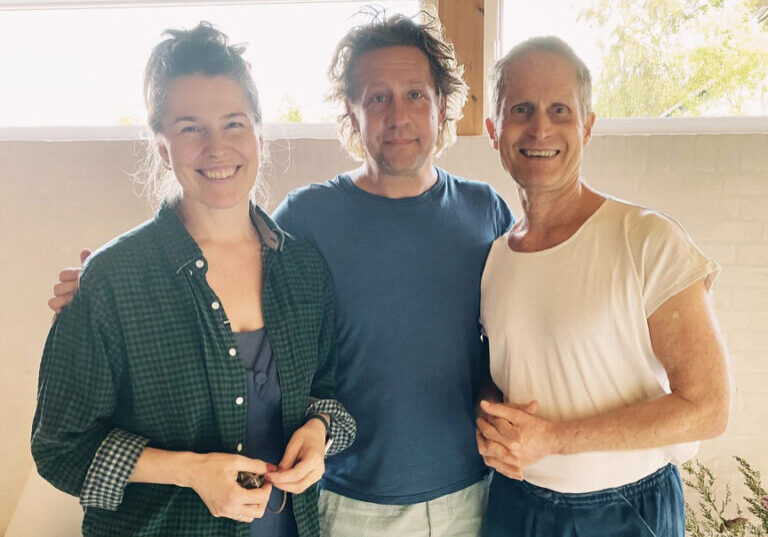
 Peter Hoeg is an M.A., author and teacher of meditation and creativity. He is one of Kontemplation's regular teachers, co-founder of the Children's Life Knowledge Association and part of the Growth Center's teaching group.
Peter lives in connection with the Growth Center in Nørre Snede and receives practical guidance from Jes Bertelsen.
Photo: Henrik Saxgren
Welcome to Kontemplations practice library: