

BLOGCAST: This post was recorded by Morten Winkler. You can listen to the blog here (8:26):
In his story 'The Lottery in Babylon', the Argentine author Jorge Luis Borges writes:
’'Heracilides Ponticus relates – with awe – that Pythagoras could remember in previous lives having been Pyrrhus, before him Euphorbus and before him another mortal; to remember similar vicissitudes I need not include death and not even deceit.'’
Borges’' stories, essays and lectures often revolve around reincarnation. In always elegant and fictional form: Like rows of people dreaming of each other, like an Inca shaman who experiences being all other people, like Shakespeare who experiences the same thing.
In the same way as in the quote above, in many places in Borges's work one can sense the fascination with, and fear of, the phenomenon that most of us Westerners can probably recognize. The idea of a form of eternal life as a stream of consciousness that takes shape in ever new bodies and personalities is tempting by opening up the possibility that death is not just the end. And shocking by the questions and objections that the idea raises: When we only know life in everyday life in connection with physical bodies, how can we trust that something continues when the body is gone?
Various ideas about reincarnation existed in early Christianity, but were later removed from Christian dogma and the Christian canon, the collection of texts approved by church institutions. For this reason – and because of the Enlightenment's suppression of the possibility of transcendence, the notion that there is a higher and truer form of existence and consciousness than that limited by language and our normal reality – the idea of reincarnation can be experienced both as forbidden or New Age-like and as an imported Eastern superstition – and as a thought-provoking concept.
Over the past 40-50 years, a number of books have attempted to introduce reincarnation to the West in a more experiential way. Famously, the book series Cases of the Reincarnation Type which comprehensively and soberly documents a long list of examples of people who claim to remember past lives. A well-known case is that of Shanti Devi, an Indian girl who from a very young age remembers a past life with such clarity and insistence that she gets her parents to take her to the man she remembers having married and the child – now older than herself – whom she remembers having been the mother of. An account that shows the possible costs of such experiences.
A book that has just come into our hands, A Story Waiting to Pierce You, by Peter Kingsley, addresses the issue of reincarnation in Western culture from a surprising angle, and the main character is none other than Pythagoras.
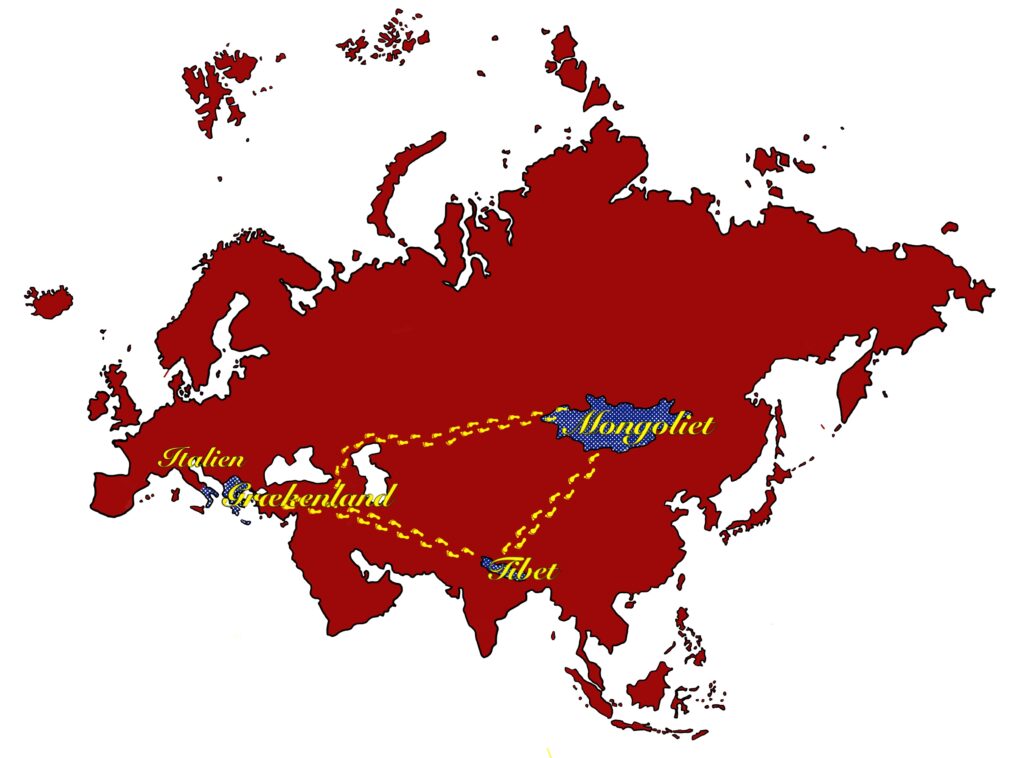
It is beyond our competence to assess the – frankly enormous – amount of sources in many different languages, including Slavic, to which Kingsley's book refers. But the book's main statements seem convincing: that Pythagoras was at one point approached by a Mongolian shaman who had travelled around Greece, that a profound meeting took place between the two, and that the shaman identified Pythagoras as what we might call a 'high' stream of consciousness, a kind of bodhisattva, i.e. a consciousness that has chosen to incarnate to help others.
The book is unusual not only in its claim that there was direct contact between Greece and the cradle of European civilization via the Silk Road at least as far back as 500 BC. It is, to say the least, special in the sense that the musical notation takes up half of the book's 180 pages. And the language is quite unusual for a professional book: at once poetic, assertive, clear, vaguely suggestive – and wise.
Pythagoras founded a school in southern Italy which, when you read what posterity has written about it (there are no written sources from Pythagoras himself), seems like a spiritual community as it might look today: daily meditations, emphasis on physical exercise and ritual dance, care with diet, a surprising attention to what sounds like partial equality between the sexes for the time. And then there is Pythagoras' knowledge of numbers and mathematics in general. Pythagoras is said to have regarded mathematics as a discipline that accounted for the inherent ways of consciousness to structure deeper aspects of reality. This attitude is also found in the Mandalas of the East, whose Western counterpart CG Jung has written extensively about, for example in the article 'Dream Symbols of the Individuation Process' (CG Jung Dreams and dream interpretation 2015 (1944) the second half of which is about mandalas in dreams.
From a contemporary point of view, it seems to us, given Peter Kingsley's impressive source material, that Pythagoras was a spiritual teacher with contact with the high part of Asian shamanism.
The view that there was contact between Europe and the East much earlier than previously realized is supported in recent years by a large number of books. We can mention Christopher I. Beckwith's Greek Buddha, who argues that Alexander the Great's conquests, as we know, established colonies in present-day India, led to Buddhist philosophy and research methods gaining a foothold in Greek culture and from there can be traced to the Age of Enlightenment and on to the present day.
Similar arguments – in other, but related, areas – are described by the same author in Warriors of the Cloisters, which traces the movement of Buddhist forms of argument from India to the Middle East and on to Spain and from there to the universities of the rest of Europe.
One can respond to these many, shall we call them 'signals' in different ways. One can say, for example, that yes, that is interesting, it seems that there was a more specific contact between Eastern philosophy and mysticism and Greek and Arabic (and via them with the European Middle Ages) than has previously been realized.
One can also allow oneself to become a little more dizzy and believe that these research results point in the direction of central parts of European culture, partly hidden, over the last 2500 years there have been active nerve fibers to central parts of the East's knowledge of consciousness training.
And so one can, in a daring moment, imagine that the rapprochement between East and West, especially between Buddhism and Christianity, which a number of figures from Father Thomas Keating to Bob Moore, Jes Bertelsen and the Dalai Lama have stated they believe is taking place, has begun long before our time and perhaps therefore, under the radar, has prepared a stronger and more significant exchange than we have been aware of.
The instructor Lone Alstrup told about an episode in the Vatican library, an episode that took place when she and Anne Hjort were preparing their film about the Gospel of Thomas. And as confirmed by the priest and author Marianne Aagaard who has had the same experience in the same library with the same librarian (and which she tells about in her book about the Gospel of Thomas: In the library there is an entire room reserved for versions of the Gospel of Thomas which is part of the texts that were found in Naq Hammadi in 1945. The Jesuit priest who is the librarian of this room said, apparently to both Lone Alstrup and Marianne Aagaard, on different occasions but with the same agitation while knocking on a copy of the apocryphal text: 'This is pure Buddhism!'.
Perhaps the East exists in the West and the West in the East earlier and deeper than we have been accustomed to imagine. Perhaps the path to a positive and mutually fertilizing encounter has been paved longer and deeper than we have thought –
The blog post is narrated by Morten Winkler.
Illustration: Kontemplation

is a meditation teacher, psychotherapist and cand.arch.
She founded Kontemplation in 2010 based on an interest in integrating inner practice into everyday life, community, and creative expression.
Hanneli lives at the Growth Center in Nørre Snede, where she is part of the center's regular teaching group.
She is also affiliated with the Children's Life Knowledge Association and has worked with contemplative practice in teaching and creative contexts for many years.

is an MA in literary studies, author and teacher of meditation, empathy and creativity.
He is co-founder of the association Children's Life Knowledge, and co-author of the book 'Empathy – what holds the world together'.
He lives in connection with the Growth Center in Nørre Snede, is part of the Growth Center's regular teaching group and is training with Jes Bertelsen.