It's midsummer. I've just come in from the garden where I've been sitting eating strawberries and listening to the sounds of the evening. The strawberries are small because of the drought. Even though it's rained today, the ground isn't really damp. The smell of after-rain has disappeared. It makes me involuntarily think about the environmental situation we, and our planet, find ourselves in.
I feel a sense of unease for the future. And also a sadness. Sadness about how much continues as usual. And about all those who are really suffering right now because of climate change.
At the same time, I feel a sense of hope. Because there are also changes underway and on the way. There are many who are coming up with serious suggestions on how we can move forward from here in a more sustainable way.
Karen Armstrong's book 'THE SACRED POWER OF NATURE. How we can restore our connection to the natural world' is such a commandment. And perhaps that is why I have now read it twice. And listened to it! The topic, our relationship with nature, could hardly be more relevant than right now.
”The catastrophe,” she writes, ”can only be avoided if we change our way of life. The crisis is created by the modern lifestyle, which – despite its significant achievements – is fatally flawed.”
And we know it well. We are overconsuming the earth's resources. And although we in Denmark pride ourselves on leading the way in the green transition, we are very far from living in harmony with the earth's resources. I read earlier this year that if everyone lived like we do in Denmark, we would have to use energy from 4.3 Earths per year!
Karen Armstrong, a former nun and described as one of the most recognized historians of religion of our time, writes that the problem lies in our worldview. Armstrong finds the cause of today's people's view of nature in the beginning of the modern age. For here God was separated from nature, and we consequently came to regard nature as something we can master and use. And it is in this attitude that we find the cause of our way of living separated from, and with an experience of being above, nature.

Armstrong's book encourages us to find inspiration to rediscover our connection to, and reverence for, nature in the Axial Age. The Axial Age is the period from approximately 900 to 200 BC. During that period, the great religious and philosophical traditions arose, Confucianism and Daoism in China, Hinduism and Buddhism in India, and monotheism in Israel from which Judaism, Christianity, and Islam emerged. And in the book, we are presented with wisdom from these traditions that we can lean on in our attempt to rediscover the sacredness of nature.
For example, we learn the concept of qi to know. A concept the Confucian scholar Fang Yishi (1611 – 71) criticized the Western world for not understanding. With the expression qi means the innermost core of all being. It is, in Armstrong's words, "the energy that permeates all living things and in its own way creates a connection between the worlds of plants, animals, humans and the divine. It is the force that enables them to unfold their potential." In other words; the energy of all things is interconnected. It seems likely that if you keep that in mind all the time it will be harder to consume thoughtlessly.
Armstrong also points to the ’Golden Rule’, which most of us will be familiar with, and which was first introduced by King Fuzi in the 6th century BC: ”Do not do to others what you do not want them to do to you.” If we take this maxim seriously and extend it from the way we treat other people to all the ’ten thousand things’ in the world, it may become obvious where we need to act differently.
I am very happy with this book. It raises many questions in me. I would like to talk to Karen Armstrong. I would like to ask her what she thinks we can learn from the current population groups who live in close contact with nature? And who precisely experience nature as alive and have personal experiences of the being that lives in everything and from which the world arises. Perhaps the questions come because I am an anthropologist and not a historian of religion. I would like all the knowledge Armstrong shares with us in this book to be brought into dialogue with the life worlds and experiences of people living today.
For example, what are the challenges of living more in harmony with nature? What are the fruits? How does one navigate a globalized, contemporary world when one knows and experiences the sacred power of nature?
And then I wanted to talk to her about how we avoid polarizing the world into 'the West' and 'the rest' on the path forward that Armstrong points out?
And perhaps the last question doesn't need to be asked. Because the answer may lie in the last chapter of the book, where she suggests various meditative practices for 'the way forward'.
”We should conclude with a thoughtful reading of the Buddha’s prayer ”May all beings be happy,” noting that it is addressed not to any deity but to ourselves: it appeals to us to extend our compassion and sympathy to others without exception. We should emphasize the prayers” emphatic inclusiveness and refusal to accept boundaries of any kind: Empathy is ”without limits; an infinite sympathy with the whole world, unlimited, free from hatred and enmity.” We should remember that the Buddha did not attain perfect enlightenment by refining his soul, but by directing growing feelings of love toward all creatures in this world.”.
I feel the hope. There are big challenges. But there are also constructive movements underway. And if Karen Armstrong were sitting in front of me now, I would thank her for making such a valuable contribution to the way forward.
‘'The Sacred Power of Nature' is published by Christian Daily Publishing.
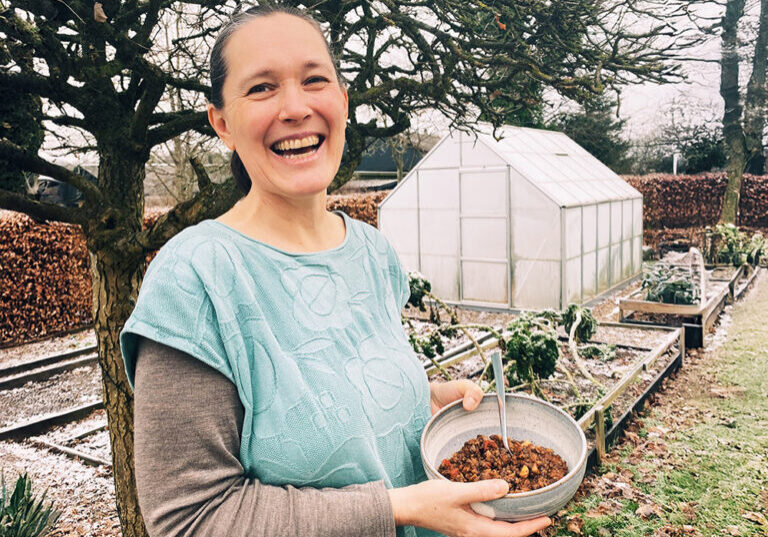
Photo: Charlotte Toft and Jeanette Lykkegaard

is an anthropologist and has written a PhD thesis on life and death processes among the shamanistic Chukchi people living in eastern Siberia. She researches existential themes such as belonging and longing, people's relationships to time, place and space, and the relationship between inner and outer relationships. She is currently investigating, among other things, the relationship of a group of Faroese people to the landscape and the sea through oral narratives.
She teaches mindfulness training, is a supervisor and leads reading groups on the course. Inner practice and working life, and has for many years combined academic work with a personal meditation practice
Jeanette is part of Kontemplation's daily life and practice.
She has broad and multifaceted responsibility in daily operations and a unifying role across courses, retreats and platforms, with a focus on well-being, collaboration and communication.
She has been a regular retreat participant for many years and has been involved in Kontemplation since 2015.