I feel the wind in my face. It has turned into autumn, cool against my skin. The sun's power is still there, but this morning it is still only weak. I feel my thigh muscles and buttocks tense every time I pedal, even though the bike is electric. The cars whizz by, making noise in competition with the sounds of the trees in the wind.
My mind takes over and I forget about my surroundings. I have read that Putin announced that Ukraine was behind the explosion on the Crimean bridge. I wonder what the reaction will be? A mobilization of several hundred thousand Russian men is already underway in response to the military success that Ukrainian soldiers are having these days in the north and south east. Military success. It is as if the two words are such diametrically opposed that they are ringing in my inner ears. Because wouldn't success mean that there was no need for the military? But on the other hand: there are several people who are now freed from an oppressive occupying power, and, if the sources are telling the truth, torture and rape. Free from war crimes. Again, a word that points to something incomprehensible, that not all war is seen as a crime.
How can it be legal, after all human history has shown us, to start a war?
Sigh. A sense of despair sets in.
I return to Ringvej Syd. The sun suddenly seems much warmer. It's probably because my body has warmed up. Despite the fact that my bike is one of those with a motor. I feel my breathing. Yes, it has changed. And my pulse is a little higher. I decide to stay with my breathing, my heart and my surroundings for the rest of the bike ride to Moesgård Museum near Aarhus. My thoughts can take care of themselves.
I am currently working on a project about HOME among mobile groups, together with three colleagues. The project is funded by VELUX, and is a collaboration between Moesgaard Museum, Aarhus University and Museum South Jutland. We investigate what home is for people who are on the move for various reasons. We work with nomads, migrants, seafarers and refugees.

My specific focus is on the experience of home among Ukrainian refugees in Denmark. Back at the office, I review some filmed interviews with four Ukrainian refugees who answer the question: What does home mean to you?
Your words touch me. They have many words. Some stand out:
”"Home for me is where my family is, my daughters and my son.".
”Home for me is where I can feel free.”
”Home for me is where I feel protected, safe.”
”In Ukraine we have the first wind of May, after the first rain. We call it the green wind or the green sound. And that is also the feeling of home. Sitting in the car, somewhere outside Kyiv, and you can sit quietly and enjoy this atmosphere of home.”
I listen to the words, to their body language and voices. And I feel the courage it must take to share this with me. And soon also with the visitors of Moesgård Museum.
The heart is open. There is both warmth and pain in the heart. Because these people cannot feel free when their country is at war. They are under protection, but several of their family members and friends are not. February 24th and the subsequent flight have been described to me as a moment of destruction: ”One moment, and everything you had built in your life was destroyed.” It is as if it closes in a little around me. The darkness. The war. All the wars. How can we have a peaceful world?
I pause. I look out the window. It has suddenly become completely calm. The sky is covered with cumulus clouds. One of them is lit by the sun, the others are gray. The image outside the window brings a kind of peace and hope to me. That is also present. The spaciousness. The trees that just stand there, towering up to the sky, stretching deep into the soil. Free from prejudice. There is a little more space inside again.
I return to the interviews and the next thing I hear are these wise words: ”There is no second chance tomorrow, we have to live today, and we have to live now.”.
I will take those words with me.

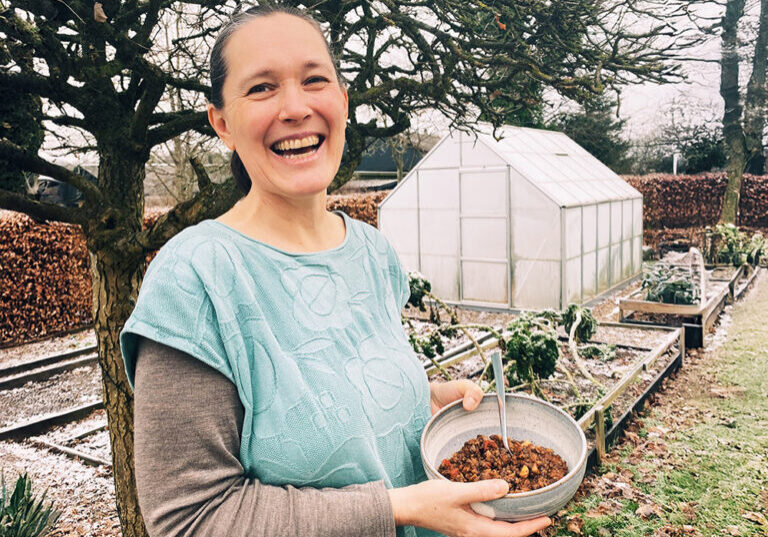
Photo: Jacob Due, Moesgaard Museum
Friday, October 14, 2022, the exhibition opens HOME at Moesgaard Museum.
You can read more about the exhibition here.
 Jeanette Lykkegaard
is an anthropologist and has written a PhD thesis on life and death processes among the shamanistic Chukchi people living in eastern Siberia. She is currently researching the meaning of home for Ukrainian refugees in Denmark.
Jeanette is part of the team behind Kontemplation, where she has participated in a number of courses and retreats. She receives teaching and practice guidance from Hanneli Ågotsdatter and Peter Høeg.