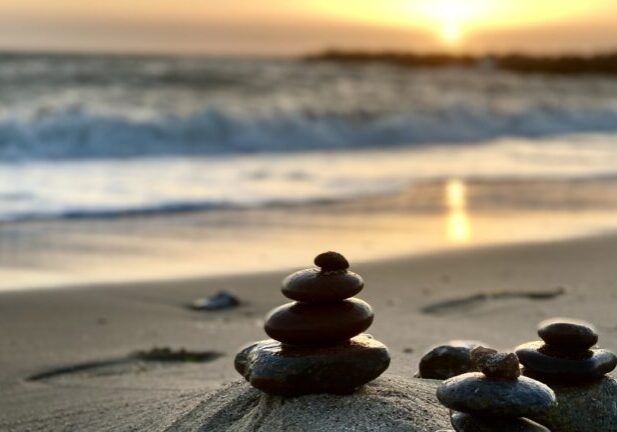


I have gold in my hand. Several pieces. Big and small. Shiny and dull. Transparent and opaque. 18 pieces in total. I sit in my meditation bag on my lawn in Copenhagen and hold 'The Gold of the Sea'.
I am by God not a big amber hunter, but I love amber. A fascination that began when I was a child, and discovered my grandmother's large, beautiful, shining piece of amber that she always wore around her neck. Early on, I also got a necklace myself – a little heart made of amber – and at the same time I was initiated into the making of amber. I immediately began, with determined zeal, to collect resin from all the trees in the backyard of the apartment building and the surrounding nature. And I was particularly happy when I found some of the resin that hung a little lower on the tree, and which was therefore a little harder – and perhaps with a little good will could be called amber. Almost all the finds were hidden in the hope that when I really grew up, I could open the box and the slightly sticky stuff would have been magically transformed into the finest pieces of amber.
As an adult, I moved closer to the sea, and it was on the north coast of Zealand that I happened to find my first real piece of amber. Suddenly, it was just there, shining at the water's edge, almost ostentatiously showing its connection to all the elements around it – the sea, the earth and the sky – while I felt it calling out to me.
When I sit here in the sun and hold that particular piece of amber together with my other clear and more milky white pieces that have been found in the years since, I experience that I simultaneously hold the past, the present and the future in my hands. I hold what has been – and is – a commodity. I hold the stories of other cultures – and not least my own history.
The gold of the sea, which we poetically call the golden stones, has been created by the forces of nature over millions of years. It's dizzying. Millions of years. The small stones become a little more overwhelming to look at and sit with.
In some spiritual traditions, it is said that amber possesses a warm and healing energy that connects us to the earth and the sun. I don't know if that is true, but I experience the connection to nature and all times – inside and out.
My legs are asleep. I get up from the pillow to go inside and at the same time leave the solid windy weather. Tomorrow morning I will drive towards the coast and go for a walk. It is good amber weather when it has been windy, they say. And maybe tomorrow I will be lucky enough to find another piece of amber created and shaped by time, the earth and the sea – a piece of amber that, as at our first magical meeting, offers itself in all its beauty and lightness illuminated by the sun on a pillow of seaweed. A piece of amber that will again invite me to insight and perhaps even insight into the simultaneously incomprehensible, overwhelming and obvious interconnectedness of nature and the planet.
I breathe a little deeper. It's as if the feeling of connectedness has slowly spread from my brain to my heart to my entire body and beyond.
Fact: Amber is fossilized resin. But amber only becomes amber as we know it when it has found its way to and lain in the ocean for at least 30-50 million years and undergone an oxygen-free process with pressure effects. The process changes the plant sap and reduces the oil content to ultimately create 'The Gold of the Sea'.
Connection – invisible threads In many cultures and stories, there is the image of the common thread – a thread of fate that weaves people and events together. Often we only see the threads when we stop. When we listen. In a time when so much divides us – politically, socially, environmentally – we need, perhaps more than ever, to find what binds us together. The invisible thread that, according to an old Chinese proverb, “can be stretched but not broken.” At a writing workshop in Kontemplation's blog team, we invited the writers to explore just that. We started close up. With a single object – a stone, a feather, a seashell – something we could hold in our hands. With open senses we listened to the object’s history, to memories, to nature. From here we wrote freely, investigating and listening. Here you can read how our writers have let the invisible threads emerge through words – as clues, as testimonies, as small glimpses of the larger context we are all woven into.
Photo: Charlotte Toft

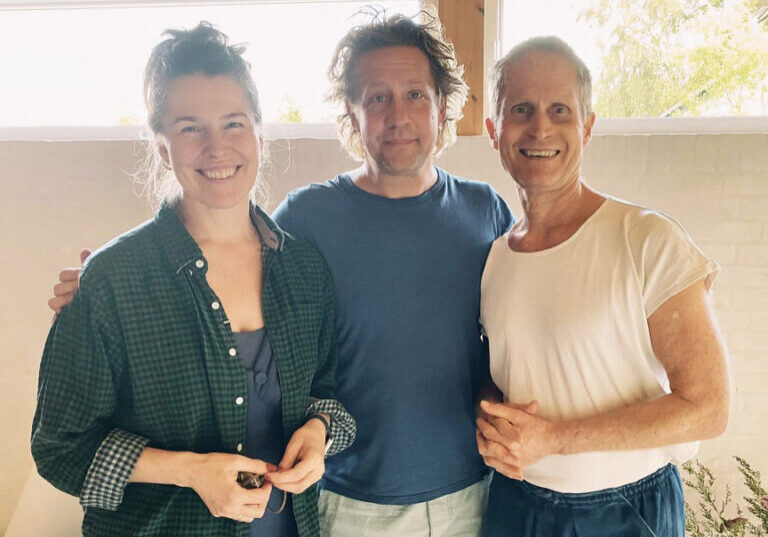
Charlotte is a trained cultural sociologist. She has worked as a journalist, editor and manager for over 20 years in relief and development organizations. Today she works as a press and communications consultant and stress consultant. Charlotte has followed Kontemplation's teaching for a number of years and attends annual retreats. She receives teaching and practical guidance from Hanneli Ågotsdatter and Peter Høeg.
Photo: Lars Schmidt