



In the left hand rests a blue, oblong, hexagonal pencil. Slightly cool, but warms slowly in contact with the hand. It has a smooth surface, but with some irregularities. It has probably been dropped on the floor, lying next to other writing instruments and has been scratched. There are scratches in the varnish.
The pencil becomes an extension of the hand, like an extension of the arm attached to a body. When the well-sharpened end of graphite hits the paper, a rough and calm sound emerges. It forms various signs, as if in a dance without any real purpose across the paper. Thoughts wander while the eyes rest on the pencil.
I remember one of my first encounters with a pencil.
A small, chubby child's hand, naturally grasping a pencil with its left hand. The violence when the adults around the small hand resolutely take the pencil out of its hand and place it in the child's right hand. Awkward.
A fight.
A feeling of wrongness.
When I started school, no one took the pencil out of my hand. In its own way, it was slightly confusing and at the same time liberating. Here, it was apparently accepted that the hand that wanted to hold the pencil had to do so.
Wrongness gradually turned into acceptance.
Min dansklærer – han hed Jakob – var vidne til, at vi var to, der skrev med venstre hånd. To piger, der af og til blev drillet af de andre børn på grund af dette.
Jakob pulled us aside one day after class. He told us that Charles Chaplin played the violin with his left hand. He also told us that great artists like Leonardo da Vinci and Pablo Picasso were left-handed. He showed us some of their works. While he was telling us, I found myself sitting with my mouth open, listening.
Jakob told us that people who are naturally left-handed are wired differently in the way their brains work. He said they often have more equal access to creativity.
Two little girls, seven years old.
Acceptance.
Appreciation.
When I walked home from school that day, I felt like I was carrying a little secret. A little shining light, a flame that I had to be careful not to blow out. I sat down in my room and took a pencil in my hand.
No wrongdoing.
Acceptance.
Appreciation.
Right now.
With a blue pencil in hand.
Photo: Charlotte Toft and Mikkel Strandbygaard

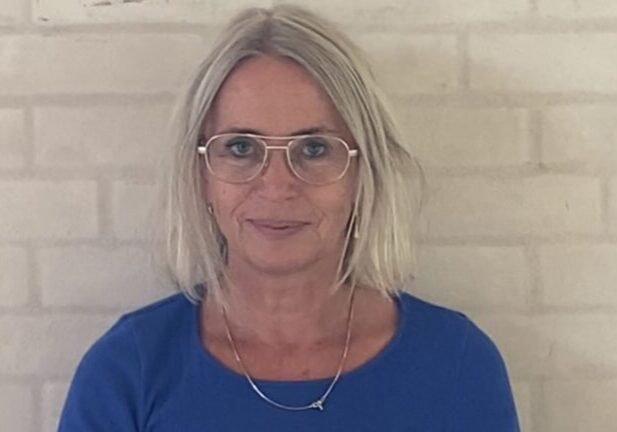
is a Master of Education in Educational Psychology with a specialization in mindfulness from Aarhus University and a psychotherapist MPF from the Vedfelt Institute. She works daily as a private practicing psychotherapist and has a special interest in dream work in the therapeutic process.
Britta has been part of the Kontemplation team since 2019 and is a teacher on the Kontemplation platform. She also contributes with existential conversations, retreat conversations and therapeutic courses. You can find her guides in the practice library and read her written contributions on the blog.
She attends an annual long-term retreat and receives practical guidance from Hanneli Ågotsdatter and Peter Høeg.











Thank you, Britta. Your beautiful story brought me back to a memory of my best elementary school friend, Vibeke, who also wrote with her left hand. We were sitting next to the hymen, and I suddenly remember very clearly my fascination with seeing her hand move across the paper in a different way than mine – and how nicely I thought she wrote – and how happy we were for each other throughout the elementary school years. So lovely and to be brought into contact with her through your words – thank you for that ❤️.
Dear Lisse.
Thank you for sharing this moving memory with us ❤️