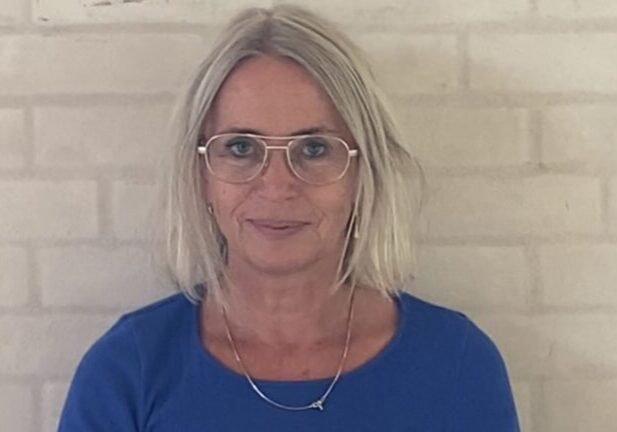
This blog post is part of a conversation between Hanneli Ågotsdatter and Josephine Lau Jessen, who is a PhD candidate in Human Ecology from Lund University.
They talk about how climate awareness and contemplative practices are connected. And about Hanneli's work for the Center for Systems Awareness, where she teaches school teachers and people who work with children in mindfulness training and systems understanding.
The conversation will touch on three themes: compassion, training in presence and climate awareness, and the connection between body awareness and global responsibility.
We bring their exchange in this and two following blog posts, each with its own theme.
The conversation is part of Josephine's thesis.
You can listen to this post as a blogcast here. Narrated by Morten Winkler (08:21):
I
’'THE ANSWER TO THE QUESTION CAN CHANGE AT ANY TIME'’
On compassion, vulnerability and the limitations of language
Josephine:
May I begin by asking what you experience happens when you, in your teaching at the Center for Systems Awareness, bring contemplative practices into a classroom where climate change is being addressed? And perhaps especially: What happens to the worry and anxiety that so often accompany this topic.
Could I also ask you to tell me a little about your background and your work at the Center for Systems Awareness in general?
Hanneli:
Let me say right away that climate change is not my area of expertise. It is only the meditative approach to this area that I teach. But having said that, I will try to answer your questions as best I can.
I originally trained as, and worked for a time as, an architect. But I later trained as a psychotherapist and from there as a mindfulness teacher at the University of Massachusetts. After that, I started teaching the stress reduction program MBSR in Denmark. At some point, I started leading retreats and joined the teaching group at Vækstcenteret.
Josephine:
Isn't it far – or at least a good distance – from a Danish setting for an international education based in the USA?
Hanneli:
You could say that. But Mette-Miriam Bøll as leader Center for Systems Awareness and the center's Master Practitioner education and I have known each other for many years, and she has both a deep interest in and a deep knowledge of the contemplative background, which is also mine. From this contact between us stems my deeper involvement with the center. Which began in earnest when the one-year Compassionate Master Practitioners Programme was initiated, and I was asked to take a significant part of the responsibility for the contemplative part of the program. This initiative has since grown so that we now also have a How to Hold Space Program and one Youth Leadership Program.
Josephine:
There is a concept in your work that interests me, and that is the word compassion. Could you say a little more about that?
Hanneli:
I must, to be quite honest, say that neither concepts nor their definition are my strong suit.
Or perhaps I should rather say that I prefer to approach subject areas from a practical rather than a mental side. In this way, I also try to avoid imposing my own ideas on those I teach. Instead, I am concerned with what they themselves get out of practical exercises. These exercises, training in presence, in the nuance of empathic feelings and the raising of body awareness, are for me just as important as the teaching of mental ideas.
Josephine:
Still, I understand that there are theoretical formations in your teaching.
Hanneli:
Yes. But they are based on experience. Asking the heart and body how the situation is right now is what really interests me. Asking with openness to the fact that the answer to the question can change from moment to moment.
For me, there are two aspects of the feelings of the heart: One is the love and care we receive in the first years of our lives, which are crucial for our early growth. But later on, it is the outward feelings of the heart, the ones we cherish and show to others, that are crucial. Which are the ones we as humans grow out of.
Josephine:
Can you teach that, outward heart feelings? And can you do it without touching on the negative feelings associated with the heart?
Hanneli:
Helping people to discover and nuance that we have this ability to give and show kindness, love and compassion and that we can give this flow of emotions a direction outward is what I try to teach. Among these, it is necessary and inevitable that we also discover the limitations of our heart feelings. Which we cannot or should not suppress. Instead, we can notice and note, for example: Oh, today my heart is not so open, it is more cautious today.
Josephine:
The heart can also be afraid –
Hanneli:
For most of us, there is a certain fear associated with opening up to our feelings, which is a vulnerable area.
Compassion is therefore directed inward, towards oneself, as much as towards others. Feeling one's own vulnerability in the heart is a prerequisite for being able to begin to work with it and open up further to others. We cannot have and show deeper compassion for others than for ourselves.
If we accept the pulsation of the heart, accept that it is sometimes protected, we have the opportunity to discover that this protection is not necessarily a contraction, but a necessary and temporary state that we can respect without self-blame.
Josephine:
Surely it also requires self-protection to dare to open?
Hanneli:
The better we humans understand and respect our own boundaries, the easier it becomes not to project our darkness and shadows – which often lie behind our self-protection – onto others. In this way, we have the opportunity to come to terms with our own vulnerability. When the heart knows that it is respected, it will be able to begin to discover more opportunities to open up.
These possibilities will eventually accumulate into a beginning feeling of heart freedom. Balanced compassion for oneself will spontaneously flow out to our surroundings. It is therefore a central part of a teaching that aims to do something for others.
Josephine:
Aren't we approaching the issue of sustainability here?
Hanneli:
Such flows of emotions, inward and outward, underlie meaningful and sustainable relationships with our surroundings. This is what makes external and internal sustainability inseparable.
For me, heart meetings between people are central to life. Mental meetings, that is, shared rational, linguistic understanding, are important. But if meetings are also anchored in the heart, they become deeper.
Josephine:
I like that formulation of compassion. At the same time, it points to a difficult point, since compassion is experienced as a feeling or a sensation, as a bridge between individuals. But because the academic world is so mental, it can sometimes feel like a struggle to give the heart aspect a place in academia.
Hanneli:
Yes, language can be a bottleneck, a limitation. When we talk about compassion and love, we risk locking emotions in the bottle of language.
The second part of the conversation between Hanneli and Josephine will be published here on the blog on Saturday, March 18, and the third part on Sunday, April 2.
Graphic design: Mikkel Strandbygaard

(b. 1994) has a master's degree in Human Ecology – Power, Culture & Sustainability
and works as a teacher in Sustainable Development at CIEE in Copenhagen. Josephine is
interested in how we can use the interdisciplinary field between art and science to
communicates the crisis we all face in creative ways through teaching, text, film
and photography. Josephine is interested in meditation and is a student at the growth center.