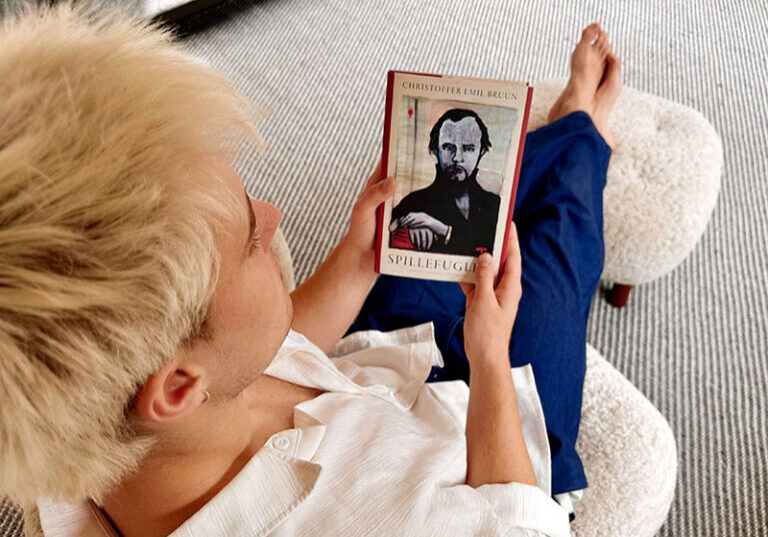


The Niels Bohr Institute's 100th anniversary book, the pictorial work Unity of Knowledge, is being released these days on Strandbergs Publishing House. Peter Høeg's text for the book raises and examines the question of what the relationship is today between quantum physics, science and art, and it continues with a brief look at the history of physics, with reflections on what the experiences of quantum physics might say about the relationship between language and reality, what physics and spirituality can have to do with each other, and with observations of what makes the research environment at the institute in Copenhagen unique.
Below we bring excerpts and images from Unity of Knowledge:
 A friend of mine attended Niels Bohr's lectures as a student.
Bohr sensed the young mathematician's passion for physics, gave him generously of his time and attention, and often spoke with him after class. Once, sensing my friend's devotion, he said: "Otto, we must remember that natural science deals with only a very narrow section of the sum of human experience.".
In that statement, one hears a scientist whose overview and format are large enough to admit his own and the limitations of the profession.
Humility is not self-annihilation. It is at once knowing and abiding by one's own importance and admitting that all understanding is always fragmentary and divided. It is being open and respectful towards all that one does not understand.
Openness and respect go hand in hand with curiosity. With interest in others, with the willingness to engage in dialogue.
This book is part of such a dialogue.
It has been created by Niels Bohr Institute has invited two artists, the sculptor Rikke Raben and the photographer Anne Prytz Schaldemose, not just inside the door, but into the heart of the institute.
The book is a scrapbook about this meeting of heart and consciousness.

Niels Bohr together with the German physicist Heisenberg
In February 2001, the magazine published Scientific American an article that made it likely that a third of total global revenue, $30 trillion, was the return on products and topics that relied directly on quantum physics-related research.
30,000 billion dollars!
There are very few, if any, people on the planet today whose existence is not in some way affected by quantum physics. It is a crucial factor behind the developments that today make us talk about the Anthropocene era. Humanity now has the power to bring about physical changes that previously only natural forces could.
The greater the power, the greater the responsibility. The greater the responsibility, the more important the ethics required to carry out that responsibility.

In 1800, Volta stacked a series of galvanic cells on top of each other to form the so-called Voltaic pile, the first battery in history. In 1820, Ørsted showed that current from Volta's battery has an effect on a compass needle, thus establishing the foundation for, among other things, the electric motor. During 1832 and 33, the self-taught experimental physicist Faraday showed that a change in magnetic field creates an electric field, thereby opening the way to the alternating current generator, power plants and windmills. In 1860, Maxwell combined these experiences in his equations in electromagnetism, the science of the physical properties of magnetic fields, thereby paving the way for the discovery and exploitation of radio waves and all controlled use of electricity. From the 1880s onwards, Tesla and Edison set about electrifying the world. In 1900, Planck was able to describe the electromagnetic radiation from hot bodies (the sun) by assuming that it is quantized; in 1905, Einstein realized, in his description of the photoelectric effect, that this is actually the case. In 1913, Bohr published three articles that combined Planck's description of the quantum with a model of energy relations in the atom. From 1920-40, modern electronics was founded. In the 1960s, the laser was invented. The transistor. The industrial use of nuclear power, which has its roots in the theory of relativity, is gaining momentum. Today, with the possible development of the quantum computer, there is talk of a possible second quantum physics revolution.
It has happened in a very short time. In these bullet points – compiled from the amateur's preoccupation with the history of science – only a few of the discoveries that, in retrospect, turn out to point directly towards quantum physics are mentioned.
My grandmother was born in 1886, she could have met Maxwell.
My great-grandfather, whose silver pocket watch I inherited, was born in 1843; he could have met Ørsted.
Development has been very, very rapid.
There is no reason to believe that it will slow down in the future.
Do we know where we are going?
In the concluding lines of his review of (especially) the history of human knowledge,
Sapiens writes the historian Yuval Noah Harari:
’'We have moved from canoes to galleys to steamships to spacecraft – but no one knows where we are going. We are more powerful than ever, but have little idea what to do with that power. Worse still, humanity seems to be more irresponsible than ever. As self-proclaimed gods with only the laws of physics to keep us company, we are answerable to no one. We consistently bring death and destruction upon our fellow creatures and the surrounding ecosystems, seeking little more than our own safety and amusement, and never experiencing satisfaction. Is there anything more dangerous than discontented and irresponsible gods who don't know what they want?'’
Photo: Anne Prytz Schaldemose and the Niels Bohr Institute.
Image selection, collages and organization: Rikke Raben
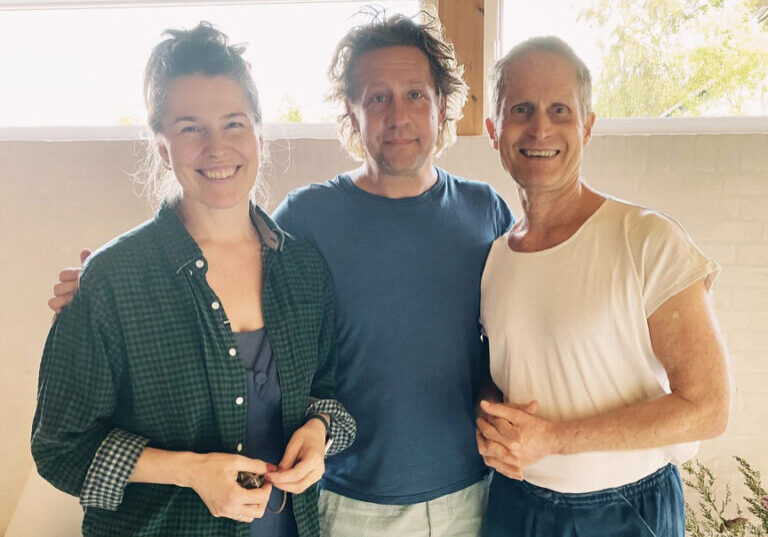
 Peter Hoeg is an M.A., author and teacher of meditation and creativity. He is one of Kontemplation's regular teachers, co-founder of the Children's Life Knowledge Association and part of the Growth Center's teaching group.
Peter lives in connection with the Growth Center in Nørre Snede and receives practical guidance from Jes Bertelsen.
Photo: Henrik Saxgren