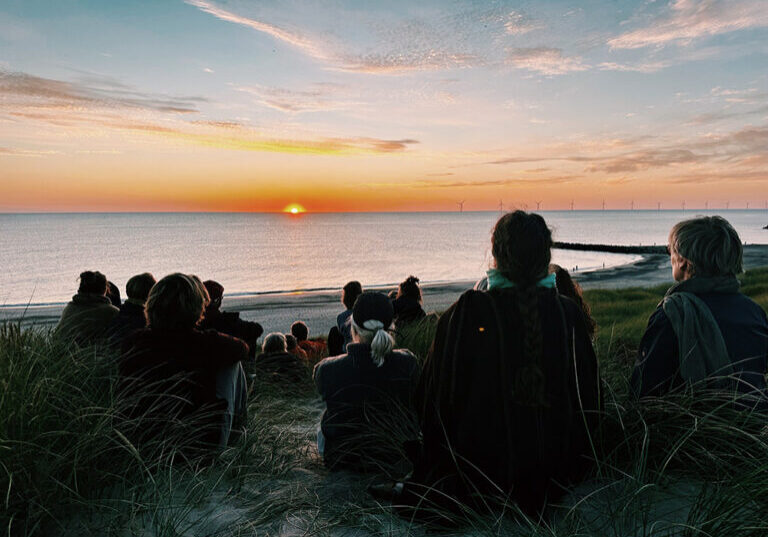


During our latest retreat at Øster Løkke, we were once again reminded of how much support you get from the landscape by the North Sea.
A retreat is a temporary withdrawal from the world, not to leave it, but to allow oneself to encounter it, and oneself, more deeply.
Øster Løkke, where we hold our retreat courses, is a carefully restored beach farm located directly on the water.
The sea, the vastness of the landscape and the sparsely populated tranquility, have at least two direct effects on those of us who come here, effects that are at once intense and obvious:
First of all, there is peace here. There are simply fewer voices, fewer advertisements, fewer shops and, in general, less social activity. There is of course nothing wrong with voices, advertisements, commerce and people, but sometimes being apart from them gives you the opportunity to feel yourself more clearly. And this, to seek out silence for a while, to be able to hear and feel yourself more clearly for a moment, is one of the main purposes of going on retreat.
Then there is another and equally important effect of Øster Løkke's surroundings: The landscape has space. Why is it so important? It is because consciousness takes shape according to its surroundings. It is something most people will be familiar with. The movement you can feel when you reach a viewpoint in the mountains or come up over the last dune and meet the sea, has, if you notice, something to do with the fact that consciousness is a co-creator of what it experiences. And itself is created by what is experienced. If there is space in what you sense, there is a view and space like over a body of water or when you look up at the sky, there is also space and freedom in consciousness.
This law takes on a special significance for meditative processes. And here two seemingly opposite strategies complement each other: limiting the space around you to reduce distraction and allowing your awareness to expand towards your surroundings:
The word 'mysticism' is derived from a Greek word meaning to close the eyes and ears in an attempt to establish the inner stillness that was part of the Greek mystery training, and of all other inner contemplation.
Over time, such an approach will lead to the discovery of an inner expanse, which can then also be tracked down by the second strategy: seeking out natural areas that themselves have the expanse.

The desert fathers sat in deserts for several reasons, to avoid persecution and to be in peace. But they also sat there because of the vastness of the desert. In both Christian mysticism – as on the Athos peninsula – and in Zen, in Vajrayana Buddhism and in Advaita Vedanta within Hinduism, retreat facilities have been set up by large bodies of water and in desolate mountain areas and in this way have been supported by the undisturbed space, undisturbed because it is open and because it is at a distance from civilization.
A similar effort lies behind the way sacred spaces are designed. Temples, pyramids and churches, in the way they look and are designed, relate not only to the dissemination of power and politics. They also contain a more or less clearly formulated attempt to support consciousness in its attempt to release its limitations and expand.
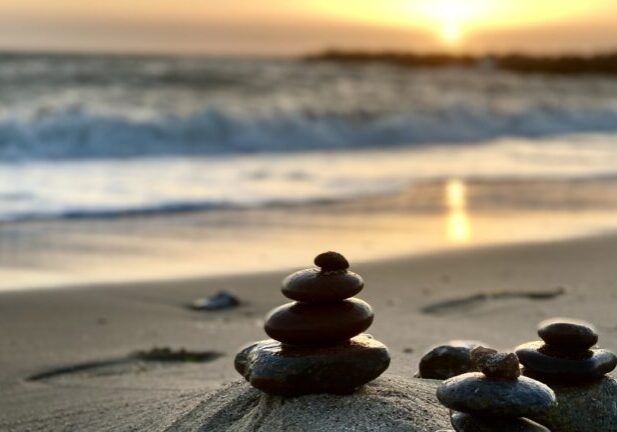
We can, say the great spiritual traditions, fundamentally neither understand nor describe consciousness. But a good analogy, a good image, they all say, is space. Free space is a good image of free consciousness.
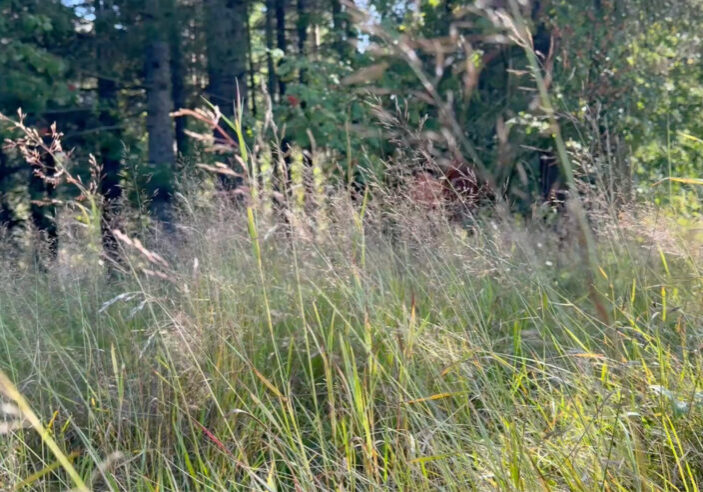
We are given that image at Øster Løkke. Here the surroundings are free, you can, as they say in Greenland, 'stretch your eyes', your gaze can expand unhindered.
The whole atmosphere is undisturbed in a way that is otherwise difficult to find. It is as if you can sense that here, for miles around, there is far less mental activity than you are used to.


Hanneli Ågotsdatter, cand.arch., meditation teacher and psychotherapist. She is Kontemplation's daily manager and teaches retreats, courses and our eight-week mindfulness-based stress reduction (MBSR) course.
She lives in an alternation between an outward-oriented working life and withdrawal in longer retreats.
Hanneli lives at the Growth Center in Nørre Snede and receives practical guidance from Jes Bertelsen.