

I wanted to live in an old dilapidated village school. And take a walk in the bog every day. That much I knew. I was in my mid-twenties, and it was probably the first major decision I made in my life that was not primarily designed to please or satisfy others. For the same reason, the ”exile” to the Bøhlandet, far out there where the crows fly, was met with anger and disbelief. For how could I be accustomed to turning my back on everything and everyone?
”It will pass,” they agreed. No one can endure living alone, isolated, for any length of time.
But I wasn't alone either. It was at a time when everything called culture & tradition was being scrapped as "bourgeois". So I thought that my place should be a niche for a forgotten and lost world. I didn't just want to remember the rejected, those who had been thrown to the dustbin, I wanted to talk to the dead. And I put their portraits up on the walls. Portraits of writers. In addition, there were the invisible "spirits" that appeared, but which you couldn't put up with drawing pins. Pictures of Teresa of Avila, Meister Eckhardt, Padmasambhava, and whatever they are all called - the sound of joy of the Sufi poets and all the other dancers on earth. Because when you are born, you are basically invited to a party.
But there was a dilemma: How to reconcile the two kinds of people, the two paths that would possibly lead to different places? The unhappy writers and the happy mystics? Writers were traditionally heavy, traumatized, introverted, boring, antisocial, and drunk. Because of the work itself? Was it an unavoidable consequence of the inward-leaning passion and inner compulsion? Or was the declension due more to the attitude, the interpretation of this work?
Mystics, on the other hand, often seemed light, bright, and cheerful.
Who and what was I – if anyone? And should one be anyone?
Writing fiction is, by definition, a work of the mind. But it is also a pitfall if you make your script your god. The risk is real. Writing fiction is an act of creation, a spiritual praxis, where you create something out of nothing – by ”doubling” yourself. ”Even the smallest measure of self-knowledge forces us to realize that the book is the product of a other "even than the self we manifest in our daily lives, habits and dishabits", as Marcel Proust writes somewhere. The worst thing about "doubling" is when it manifests itself in a real double or stalker, as it is called in the digital age, where identity theft is becoming increasingly common. Widespread or not, it must still belong to Freud's definition of the fundamental "unheimliche".
The difficult thing is that existence itself threatens to become a shadow life in relation to what unfolds in the letters on paper – just like in H.C. Andersen's fairy tale "The Shadow". If what gives life is that one opens oneself to the unknown through language, the same inspiring praxis risks robbing the author of a life of his own, which can then only be compensated for by awards and praise and fame, which will turn out to be a punishment in disguise. But one does not know that at the beginning. That one risks feeding one's shadow.
The work of the writer, from my place of work and being, consists of developing a consciousness that observes consciousness. Preferably by drilling into pain points – why not? – and preferably by making the collective unconscious conscious, even if you don't quite know how or what you're doing. Waking up every morning with renewed life energy and rushing to some pain points and existential torments, who cares?
One can hardly imagine a work more contrary to the recommendations of a Buddha! Unless the confrontation with the material also becomes a transcendence: I enter into it, while at the same time I rise above it. To write the depressing forward, light and funny, why not? If one can. But the blind spot of the author will probably always be the question: Why is it so important to write books? And for whom?
 Traditionally, the act of writing has been considered a sacred (male) act: ”Hush, hush, father writes with ink”. This male profession has historically been exercised as a tyranny for those closest to him. I think of Knut Hamsun’s hysteria about disturbances that ”should not be allowed to happen”. I think of all the families who have crawled around in tights out of fear of a line being drawn on the paper at father’s desk, because imagine if he was interrupted in his midday nap and a bird started chirping. The act of writing, as a spiritual practice, has been burdened by standing highest in the hierarchy – creating something out of nothing belongs only to gods. While most people have had to adapt to the demands of society and submit to the expectations of their surroundings, the writer, who has almost been the only one – on a par with vagabonds and criminals – has worked on his own terms. He has been a free man. And precisely a man. Was that the kind of person I wanted to be?
I found a way out of the dilemma of hysteria by demystifying the calling of the writer and seeing it as a praxis on par with any other meditation: a ritual visit to the courtyard of hell, a transit-bardo journey, a concentration that may well shut out the flickering news of the outside world, but which is really just a form of breathing. Breathing through letters, yes. If life as such is an inhalation of impulses, reading, remembering, seeing and hearing, writing is an exhalation.
But what if you yourself risk turning into a spirit?
The slipper maker Hartvig Nielsen saved me from that risk. He referred to Ahasverus, the shoemaker from Jerusalem, who dragged Jesus out of his workshop on the Via Dolorosa, and who then had to suffer the torture of wandering restlessly on earth, unable to die. The ancients knew their Bible story. It is only now that I see how HC Andersen imagines the eternal Jew as a parallel to the fallen angel Lucifer, who spreads light but himself stands in shadow.
The cobbler turned my grass into a brandy when I paid him with a case of beer, and said that you have to hate the garden a little. I think of him every year when I mow the hedge: I have to remember to hate the hedge. When you don't get that many impulses from outside in an outdoor desert, but most of it has to come from within, you risk becoming "holy". That's why you have to constantly make sure to prune yourself. The Sufis talk about the "circumcised heart".
The slipper maker not only taught me to ”hate the garden”, that is, to cultivate it so that it does not grow wild. But I saw that in this place I was surrounded by strange people who devoted themselves to quite exotic tasks that were so far removed from everything I had grown up with: baking bread, cooking black pudding, pickling berries, skinning and plucking game and butchering. That is why I perceived these strange actions that made the bread rise and the jelly set – as ”sacred”. All the ordinary everyday actions were a kind of meditation in all their purposelessness, since you could strictly speaking buy everything ready-made – but far enough away without a car. When my neighbor’s wife got up at 6 in the morning in the pitch darkness to clean windows – a service that went unnoticed – I read a deeper meaning. Not just as a civilizing contribution, but an act of love, like the stocking she knitted or darned or all the roasts she put in the oven day after day, without it being a ”gender role”. Of course it was. But I translated the whole of ordinary non-alienated life into a ”sacred act” and elevated these ordinary people of the place to a mystery, when I inscribed each bank roast, the whole of agrarian everyday life in the Gothic tapestries* from the Middle Ages: The Lady and the Unicorn, representing the six senses: To see, to hear, to smell, to taste, to touch.
The last tapestry is the sixth sense – À mon seul désir – which could be called everything between heaven and earth, from the third eye to the alchemical wedding. I named my tapestry: ”You can’t roast a pig that has been in a fight” after a saying that came from my neighbor’s wife. She must have known how pigs behave when they are about to die, and that they taste like that, because she slaughtered them herself.
Meanwhile, I spent the time developing my own six senses. Quite aimlessly, no doubt, but from an inner certainty. The intellectual, male role of author with glasses, ashtray and whisky bottle did not appeal to me. I wanted to live a more succulent life and placed emphasis on the aesthetic-visual, both when it came to the interior design of living rooms and the clothes on the body. Colors and form. Figure and fire. Just as one should be passionate about what one writes, with icy cold awareness of form. I wanted the house to smell lovely, and I wanted to breathe in beautiful flowers in the garden. And I wanted, in all my solitude, to wear perfume every day. In honor of the mice, if I may say so. (The bodies of mystics are known to smell absolutely wonderful!) And I wanted to cook the most delicious food for myself every day and taste the roasted partridge and the skinned hare with care. And especially I wanted to taste the earth through the vegetables that my neighbor proudly pulled out of it, as if he had made them grow himself. You can fertilize and you can water, but why something grows or withers, no one knows.
All the time I had to be careful not to think that I had arrived in paradise or that the Holy Sepulchre was well-guarded. Because it is not. Even though earthly life is paradise itself in a flash, and eternity is here and now, no one is spared the hardships of life. Funny word. Because it just means that life answers back. We are not alone. Answers come all the time. Even those we don't exactly want: Love sorrow, loss of hope, faith and relationships, illness and death. The impermanence of life, in short.
You can choose to perceive the terrible answers you sometimes get as an expression of life's great humor. Even though you can easily cry for years about something. Every now and then you laugh at the same time. And you know that there is a meaning somewhere, even though it may be hard to see. The things you can't get over, and that become life-shaping, endow you with a destiny. That's fine, it's not available at a discount.
Illness gives an extra bonus. Most people say they wouldn't be serious without it. But you shouldn't cling to that either.
Of all the senses, hearing is the one that has given me the most and the one that has given me the most. Hearing the silence. The different silences. I had worked with music all my life and wondered why I didn't have my own songs in me. Or – I couldn't find them. I had written in all genres, but no songs had come to me. It wasn't until late in life, when I became terminally ill and life might prove shorter than expected, that it became absolutely necessary to find my song. But I couldn't do it alone. So I sought out the music venue in Fladstrup that wants to know that the music already exists within you. When this highly musically developed "mentor" made a few nuances on the piano and I sang them at the same time, we looked at each other. It was like a speechless opening. In the next few years, we practiced improvised music on the spot. I came up with the lyrics, the music was created together. A music that had never existed before, but which we could both hear before it became sound. It was a completely unexpected expansion of my being, but at the same time, in the music that was not yet there, but was constantly becoming, I met who I had always been and originally was.
When, after almost twenty years as a recluse, I chose to adopt a love partner who was ready to live this strange life that had become mine, and it even resulted in a living child, life had new answers ready.
Because if you have learned the art of non-attachment, it is put to the test when you have a newborn child in your arms. That must be one of the reasons why monks and nuns have traditionally been forbidden to start a family. It binds in love. You can't make your child a letter in the alphabet. Or a meditation. But you can always let it go when you want.
Little children are life's best gurus – "let them come to me" – because they throw us back into ourselves and our own unconsciousness. You are always learning something new: Learning and loving are the same.
Everyone has the opportunity to get to know children. Therefore, the path is open to everyone. And it is so cleverly arranged that it does not require any higher education.
But does it require a higher education to die? "Hush, hush, I don't want to be disturbed, I'm about to die, and that's very interesting," as the man with the bowler hat says in the book Tone.
But in reality?
I guess death is an erotic thing, like when you were young and surrendered. When you gave yourself to a complete stranger you didn't know, but came to know in their embrace. This special trust and familiarity is perhaps a form of education? Like the act of creation. If you can create something out of nothing, you can also create nothing out of nothing.
Every day for almost half a century now, I have taken the same twenty-minute walk in the bog below my schoolyard. A habit, a routine, or a practice that outsiders are said to find deadly.
But that was probably the ”kill” I had intuitively sought once upon a time, in the late sixties, when I found the old school in West Zealand and decided that I would go on a ”retreat” here, if there was such a thing. ”To write” was what I heard inside my head. But life has shown that it was perhaps something else and more that it was about. Because I ask myself whether the books are not just waste, waste, the fruit of a walk in the bog, this journey that has now lasted most of a life.
*Cluny, Paris
Photo: Lars Gundersen
Mo-zen first published in 2017 as a contribution to the article series Spirit in Everyday Life.
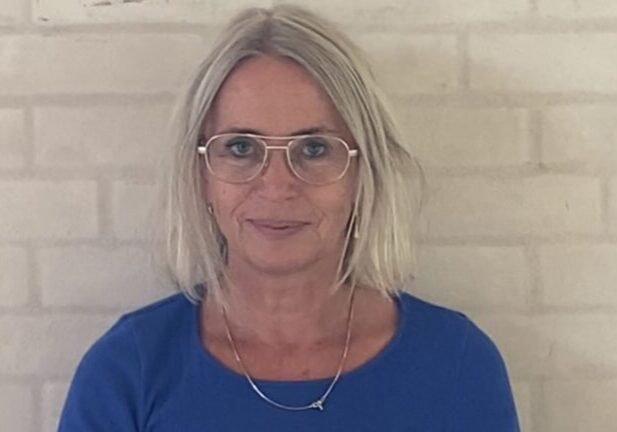
 Suzanne Brøgger
needs no introduction. We can only confirm what everyone knows, that she is one of Denmark's most important, most discussed, loved and heretical authors. And the first to, long before others dared or had the idea, break down and then dance on the border between existence and fiction.
See her bibliography here.