

Experiences from the Family Retreat – a pilot project
of | COMMUNITY & RELATIONSHIPS | August 10, 2018
We know how important an experience a retreat can be for adults.
But can you give children and adults a shared experience of just a little of the depth and intensity of withdrawal?
That was the question we at Kontemplation asked ourselves for the family retreat we held this summer at the (wonderful) camp school Over Koen out to the Limfjord a little east of Hvalpsund.
Actually, it wasn't us who first asked the question. It was several of our students who have come to us over the past few years and asked: Can't we give children a share in the undogmatic training of body awareness, presence and empathy that is Kontemplation's heart?
When teaching meditation, it is good to be very responsive to what is being asked of you. As a teacher, you try as best you can to step aside and make room for what is collectively necessary. And this necessity often comes to light as questions and requests from your students.
So we decided to try to set up this pilot project: a six-day retreat where families of all kinds were welcome. Large families, divorced families, blended families, grandparents and grandchildren.
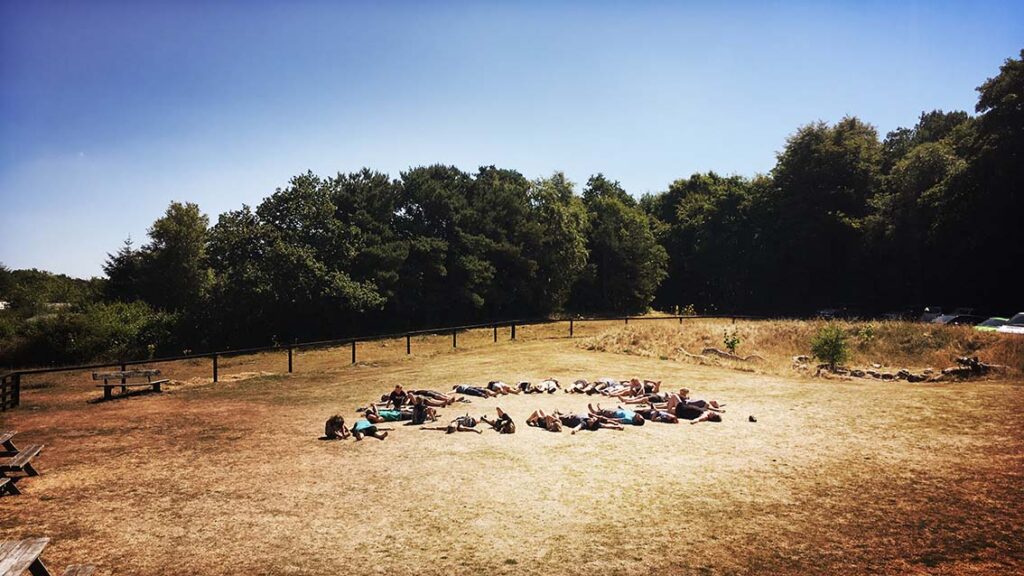
It worked. As of this writing, the retreat has ended.
It's gone well. Better than good. Better than we dared hope.
We have been around 40 people in total. Of these, nine are in the team group, seven are teachers, Martin, Mads, Celinah, Daniel, Hanne Linde, Hanneli and Peter, Mikkel and Lasse in the kitchen.
The days have been built around a stable structure, breakfast, morning gathering, meditation and yoga for adults, play and mindfulness training for children, lunch, afternoon break, afternoon lessons, dinner and evening gathering.
Periods where children and adults were separated have alternated with periods where we were all together as a team.
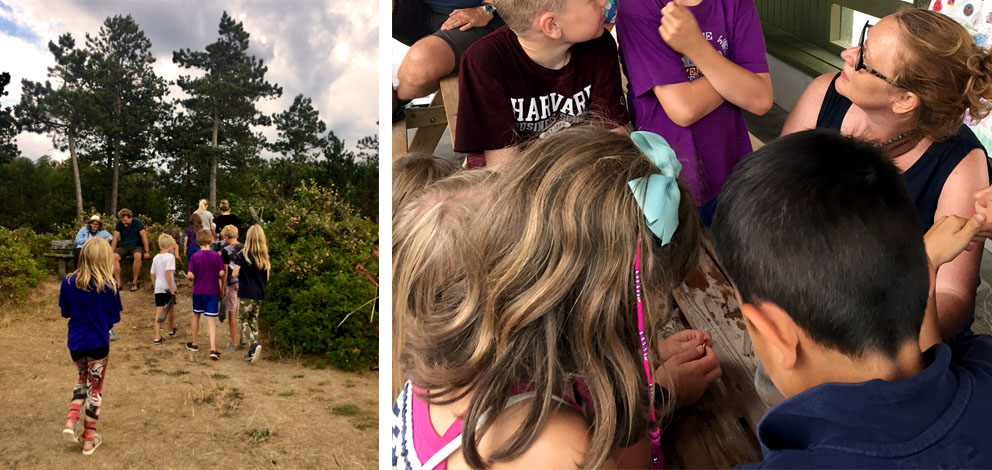
Most of the time, the entire group of children – 21 children – was together, but we also worked (and played) with them in smaller groups.
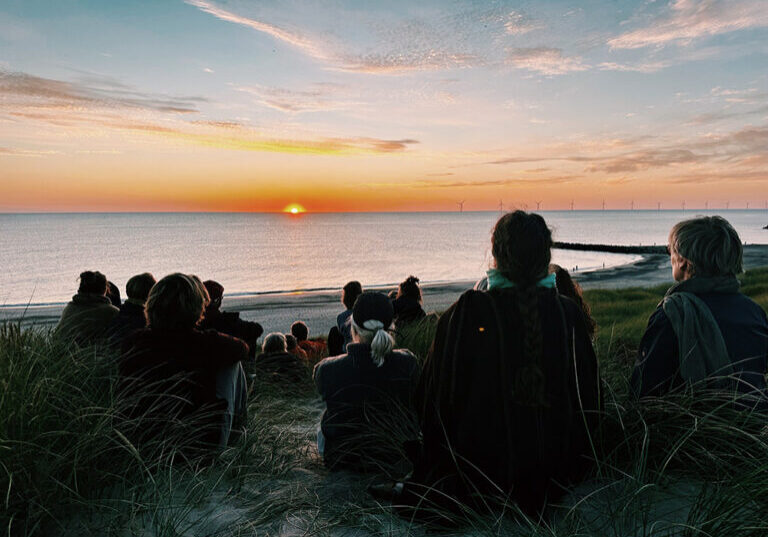
We were lucky with the weather. In this, also worrying, dry summer, we had sunshine from morning to evening and moving, orange-golden sunsets over the Limfjord.
We were also lucky in that our plan for the process, including the idea of separating children and adults, worked.
There is an almost overwhelming amount of experiences left in my memory after this retreat. It is difficult to do justice to the fullness in a short text. So it must be an almost schematic summary of especially the experiences that we in the team bring forward:
Yes, it is possible, in this way, to give families shared experiences with the possibilities of a retreat where children and adults are together.
Towards the end of the retreat, some summaries were spontaneously expressed: Almost all adults have told us that this retreat has given them a joyful experience of now sharing experiences of presence and heart training with their children. Hanneli and Martin, who taught the adults yoga and meditation every day, received feedback that it is possible to go deep into the adult program while having your children a few meters away, as long as you trust that they are being taken care of.
Another important conclusion is the one we started with in this short post: That it seems like a good, perhaps necessary, approach to divide children and adults in this way, it is an approach that everyone benefits from.
In relation to the children, the approach we chose, i.e. many kinds of physical play, dance, various forms of visual art and summer life with swimming, seems like a great starting point for contact with integrated mindfulness training.
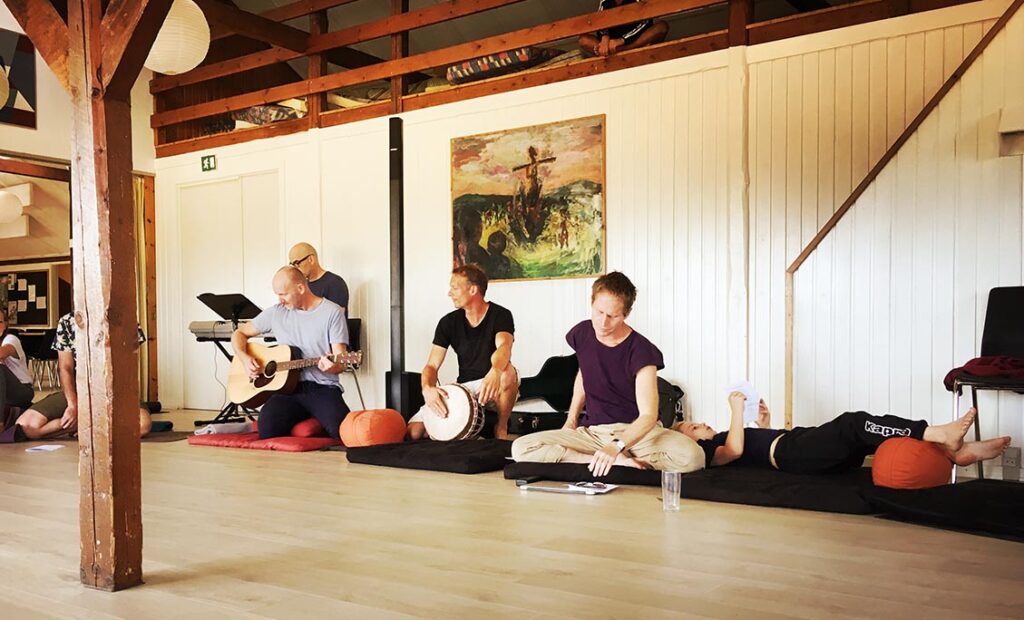
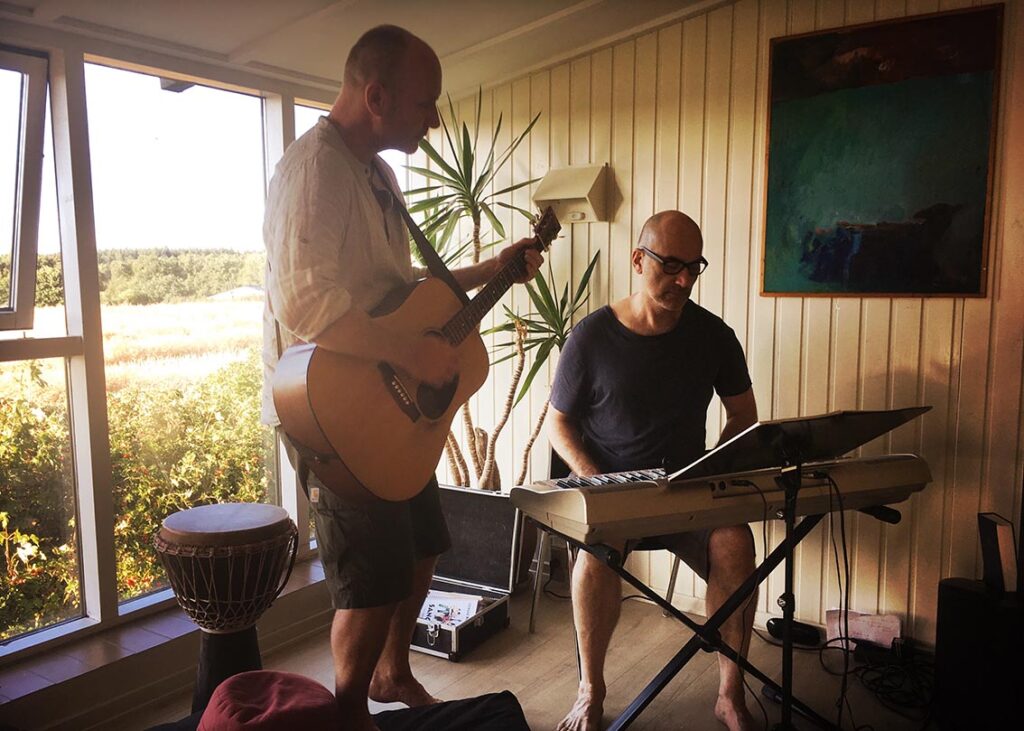
From the Danish folk high school tradition, which we are of course inspired by, we know a number of the qualities that we tried to bring with us to Over Koen: The importance of music (in the team, both Mads and Martin, in addition to being meditation teachers, are musicians, so we had a lot of musical input), the importance of play, the value of shared nature experiences. The importance of creating a non-hierarchical, trusting, non-judgmental environment. The value of dance (we danced every day). Of democratic dialogue.
What we add to this important tradition is the presence training. The meditation, the yoga, the empathic dialogue and its and our knowledge about relationship competence. About how to handle conflicts.
It is our experience, reinforced by this family retreat, that children are highly receptive to mindfulness training.
For example, the pause. In a way, you could say that the essence of meditation is understanding the meaning of the pause.
Most children are unfamiliar with breaks. Understandably, the culture has very little understanding and space for the importance of breaks.
Properly approached, the break is a deep, regenerative relaxation in which innate talents for creativity and empathy can begin to come into their own.
When you first suggest to children to be quiet for just a minute in a group, they start giggling. Or they become unsure. Maybe a little scared.
As a teacher or parent, you should not let that get to you. Children usually only know silence as embarrassment. Or perhaps as punishment. But if you patiently continue to give them silence as a gift, as an opportunity, you will be able to let it last a little longer every day. After which the children and young people begin to say, as they told us, that they discover that silence is a relief. A liberation from the noise that is normal in everyday life, school and society. Is an opportunity to feel better about yourself.
Silence is not something we can just do, neither children nor adults. We think that if we don't say anything, we are quiet. But silence is more comprehensive than the outer silence. Real silence is an inner quality. It is beginning to discover how strenuous thoughts are, and that you don't have to be a prey to them. It is discovering that consciousness is always bigger than even the biggest thought. That you, that we all, have an open space of consciousness through which thoughts can drift like clouds across the sky.
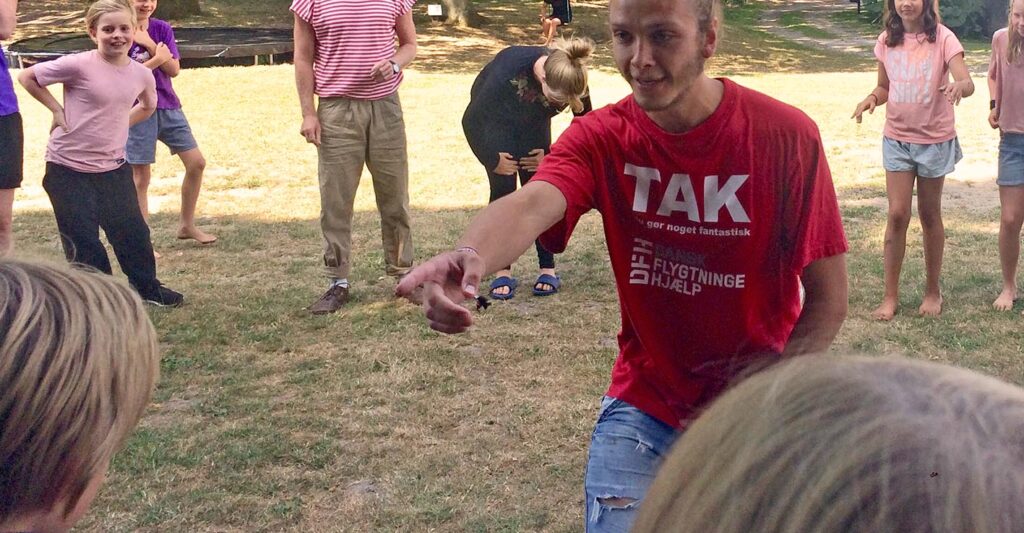
Children should not, of course, practice meditation systematically. Children are very rarely interested in any form of systematic training (but if they express such an interest themselves, we of course think it should be accommodated).
Children should play and twirl and sing and dance and fight and cry and be comforted and do all the, often dynamic, things that children naturally do (that it can be difficult, with our overly sedentary and mentally challenged school system, to be allowed to be dynamic is another matter that would lead too far to address here).
But alongside this natural active extroversion of children and young people, if they are allowed, they have a deep joy in silence. In the calmness to feel themselves. In physical relaxation.
You can give them this by incorporating small touches of introversion into everyday life, at school and in the family.
That's what we experimented with at the family retreat. For example, Mads and Peter did acrobatics with the children. And, in the focus that it requires, for example, to lift each other, we included an invitation for the children to notice and become aware of the process of mutual consideration that acrobatics requires. Or we played different forms of hide and seek and used the natural pauses in the game to make the group aware of the pause. By asking, for example: What happens in your body when you become quiet?
Celinah led a stretch where the children collected materials on the beach and in the forest to make mandalas, figures that combine the creative joy of working with shapes and natural materials with an introspective attention to what the children and young people experience as important themes or values in their lives.
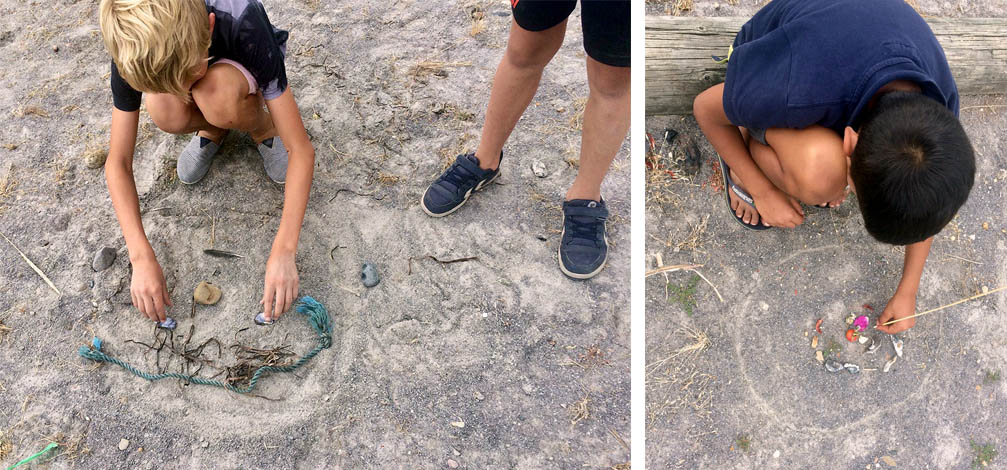
When we give the children these tasks, we try to create a space in which there is no specific answer. Whatever they experience, for example, during the break or the silence, it is interesting. If it is boredom or restlessness, those are also interesting and welcome reactions. It is important that the children understand that in mindfulness training there is never anything wrong. Boredom and restlessness are common human reactions.
And they are exciting. Boredom and restlessness are borderline phenomena. They appear when the child – or the adult – is on the verge of something new. If you let the child remain in the boredom and restlessness, without trying to take the discomfort away by suggesting a possible release, then it rarely takes more than a moment for the child to come up with something new: a new game, a new way of doing things.
Boredom and restlessness are thin veils behind which potential creative breakthroughs are hidden.
Of course, conflicts occur when 40 children and adults are intensely together for a week in a limited space.
We didn't have many. And those we did have, we solved together. With the same interest and care with which we try to meet the positive experiences. Conflicts contain information, contain messages. Children always try to cooperate. If they express suffering or discomfort, there is a message in their behavior, a chance for us adults to look at our part in the conflict as well. In families – and classes and kindergartens – children often (perhaps always?) come to bear the burden of our adults' unconsciousness.
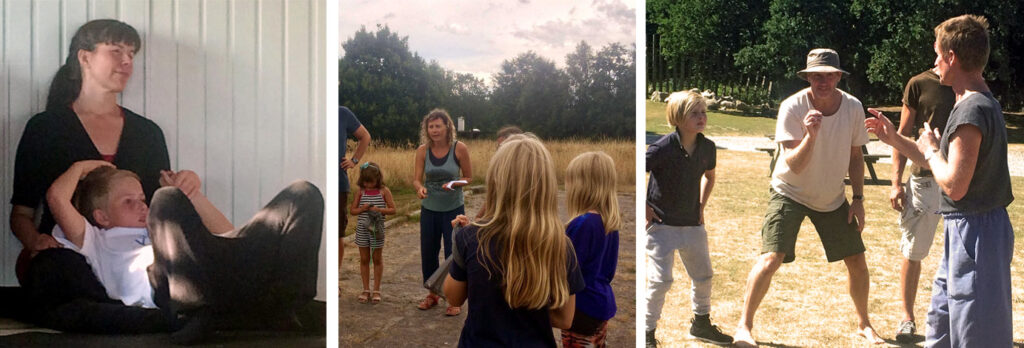
There are also things we will do differently next time: We will have a separate program for the young people, i.e. the age group 12 years and up. They will have to be taught in their own group, with the possibility of activities that speak to them. With one or more adults taking care of them specifically.
Perhaps one could begin such a retreat by gathering this age group and asking them what, besides mindfulness training, they would like to work on.
And most importantly: We must, in an advertising text for an upcoming family retreat, emphasize that if families are to include young people over the age of 12, these young people must really want to spend a week in this way. They must themselves express an interest in mindfulness training, meditation and the like. Otherwise, there will be unnecessary conflicts of interest. Young people over the age of 12 are, as we see it, so big that when it comes to something as intense as mindfulness training, you have to let them choose for themselves.
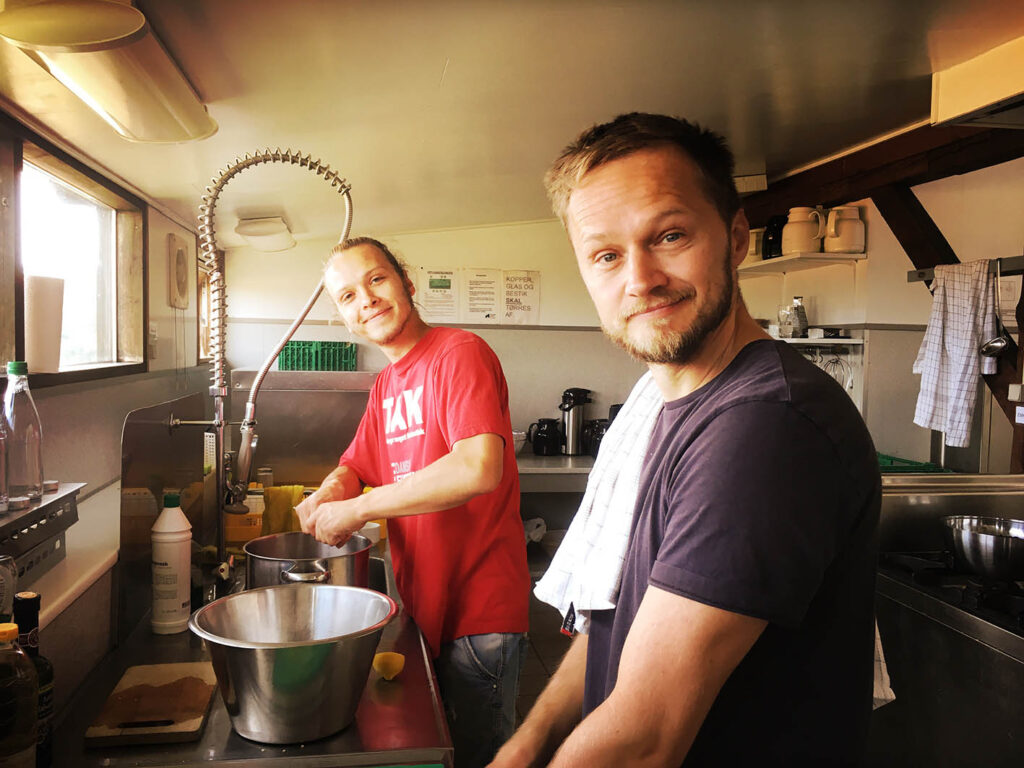
The experience from the kitchen, with Mikkel Strandbygaard as head chef with Lasse in particular as head chef, and serving all the families and all of us in the team, is a whole chapter in itself that deserves much more space than it can get here:
It worked well with exclusively vegetarian – and of course organic – food. With dishes like pita bread and lasagna for dinner, a lunch buffet with soup, freshly baked bread, butter, cheese and salad, children have the opportunity to choose.
And vegetarian food is best suited for retreats, it is lighter than meat food, and it sends a signal of sustainability, which is part of the natural attitude behind training in presence and cordiality.
And so – again – Mikkel succeeded in cooking so that every meal is delicate, creative, filling and nutritious, not just for the body.
The family retreat has been a pilot project, we always knew it would be.
This means that it has required extensive resources. The fact that there were eight adults plus ten-year-old Daniel in the organizing team and that parts of the preparations have been going on for nine months says something about what it has required.
But it has been worth it. We find that we organizers have the same experiences as the participants have expressed: That this is a phenomenon, an idea that deserves a future. That it is possible for children and adults to meet in a deeper way when play, music, creativity, togetherness and mindfulness training are brought together in this way.
Warm greetings from the team behind the Family Retreat:
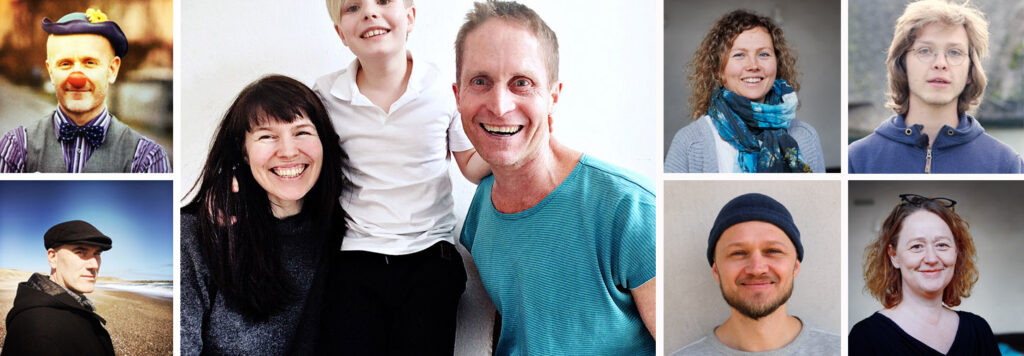
 Mads Jakob Haagen is a musician from the Royal Academy of Music and a hospital clown and teaches children and adults Stomp, mindfulness and community singing. Together with physiotherapist Iben Iversen he leads Resonance – Play for Life who create projects for refugee children that support the children's ability to self-regulate through play and music.
Photo: Pia Enghild
 Martin Goldberg is a singer, screenwriter and composer. He is a cand.phil. in musicology, and a lecturer at the Department of Culture and Communication, Aarhus University. He has been the director of Den ny Opera, and he has written a number of music-dramatic performances with children as the primary target group, and has been involved in several outreach projects for children and young people. He is a trained yoga teacher and teaches yoga and mindfulness, voice training and communication.
 Hanneli Ågotsdatter is a psychotherapist, meditation and yoga teacher. She teaches the Relationship Competence training, leads Kontemplation's retreats and courses in mindfulness-based stress reduction (MBSR). In addition to her teaching, Hanneli guides young people and adults, individually and in groups, in empathy training and inner processes. She receives practical guidance from Jes Bertelsen at the Vækstcentret in Nørre Snede.
 Peter Hoeg is a master of arts, author and teacher of meditation, empathy and creativity. He is co-founder of Børns Livskunskab and leader of the association's course in relationship skills. Peter lives in connection with the Growth Center in Nørre Snede, and is in training with Jes Bertelsen. Photo: Henrik Saxgren
 Daniel Sebastian Hoeg is nine years old and “co-teaches” at the Family Retreat. He has taught stage fight and creative play for children and adults on the relationship skills training course several times. See blog post about his teaching here and here.

Celinah Malue Jakobsen is a psychomotor therapist and teacher of yoga and mindfulness. Celinah is part of the team behind the training course in relationship competence that Kontemplation arranges in collaboration with the Children's Life Skills Association and Ikast-Brande Municipality.

Hanne Linde is a visual artist. She is affiliated with the Danish Arts Foundation's artist-in-residence scheme and is also a trained mindfulness teacher. She has extensive experience teaching both children and adults in visual art, presence and creativity. She is part of the team behind the training in relationship skills for people who work professionally with children and young people.
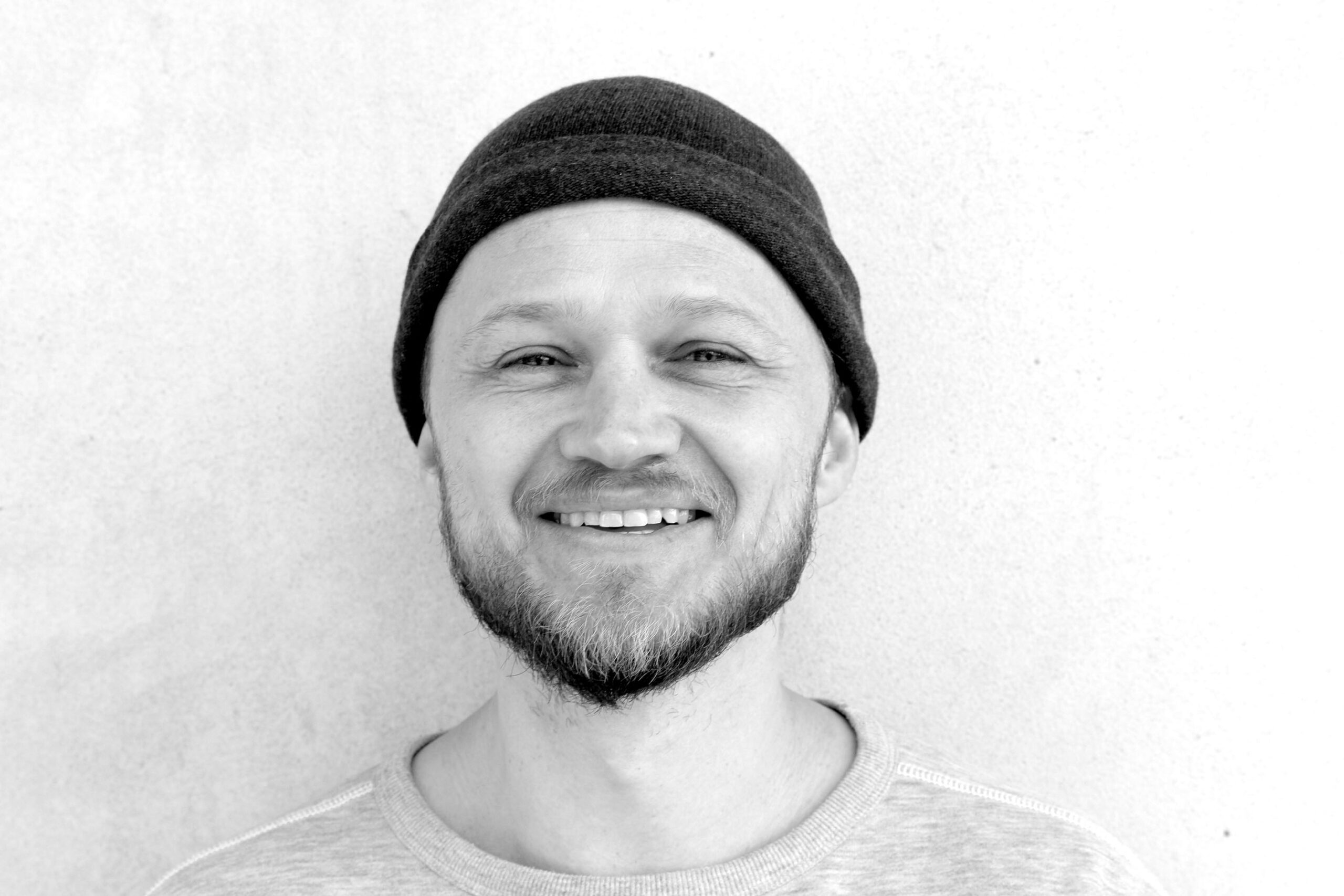 Mikkel Strandbygaard is an architect and passionate cook. Mikkel is our chef.

Lasse Dumke is a biology student and Mikkel's assistant in the kitchen.