When we seek answers in a world where there are no tables and calculations, where the equation does not have a single answer, but rather is different depending on who sets it up, it is often because we are in some kind of crisis. Perhaps we are at a point in life where the natural processes of change are setting something in motion within us, the transition from one stage to another, summer turning into autumn in the perspective of a life. When this happens, the need arises quite naturally to find a space where the feelings associated with the specific life events can be allowed to be, without having to make them go away, make them better or move on.
Such a space can be hard to find in our society today, where there is a constant demand for development and progress, and where what is part of human life, such as birth, death, grief and illness, does not bring anyone or anything financial gain, but on the contrary, it brings progress to a standstill. It is not necessarily a specific physical place, but of course it can be. In fact, it can be many things, a person, a place, a feeling. Whatever it is, it is a necessary space. For me, it is a kind of alertness, which I call the space of conscious love. It sounds both high-pitched and serious, but it's actually not at all, and when I went there for the first time, I had no idea that these were precisely the words that would now, eleven years later, make sense to me.
First time I came into contact with the conscious love, I was at a point in my life where a change was necessary. Most people know it. It is not a place you arrive at by train, bus or plane, but rather a place inside that is, in its basic substance, a ”something”. I can best describe it as the opposite of momentum, the opposite of moving on, getting over it, getting through it. I experienced it as a need to jump off my personal hamster wheel, an inner urge for change that stemmed from a set of values about how I should be as a mother, and as a longing to find peace in being in the world without having to constantly perform. The first because I had four children who suddenly meant everything to me, and the second because my constant and well-internalized demand to perform gave me anxiety. I was barely forty years old and had a feeling of having performed since I left for New York at seventeen. Now I was at a point in my life where I had graduated as a psychologist and had been awarded a PhD position at the University of Southern Denmark. But I also had my four children, the youngest of whom was only three years old. Suddenly it dawned on me that if I continued to perform as I had always done, it meant working 8-10 hour days, and the consequence of that was that my children would have to be in institution for a very long time every day. It meant, for example, that that little, lovely dark-haired boy with the trembling lower lip, who every day at two o'clock, after he had slept through the afternoon at the nursery, would run down to the fence and weave his little thick fingers into the wire mesh to wait for his mother, could end up standing there for a very long time. The thought was unbearable, my whole being bristled against it. Was he going to stand there and wait for hours for me to get three infinitely indifferent letters in gold on an equally indifferent business card? Just to prove I was smart. Who was I supposed to prove it to? And was that really what I wanted with my life, was that how I wanted to be a mother? At the same time, I suffer from anxiety. An anxious, restless feeling that lives deep inside me, and that takes over in certain situations and makes my life difficult and sometimes unhappy. I wanted to get rid of the anxiety, and maybe the solution to that riddle was in the spiritual universe? God knows, I had been through most recognized psychological methods without the big breakthrough. The anxiety lived there, and no matter what I did, it wouldn't go away. Could the solution be to learn to live with it?
 So, out of a desire to take care of my family and work on myself on a deeper level, I quit my position at the university before I had ever started and signed up for a meditation course.
What was important to me was that I didn't do it out of duty or to be recognized. It wasn't to become better at something nice, to become thin or beautiful, to get in shape, to become rich, to become something great. I did it because I wanted to and out of inner necessity. It should be added that for me, doing something out of desire has been a difficult exercise. I am incredibly disciplined and ambitious, so taking a course without getting a diploma or something nice to show the others, how much I have contributed and accomplished can feel overwhelming.
The first time I sat on the meditation cushion and closed my eyes to be with myself, I almost felt nauseous. I felt dizzy, I was struck by the fear of falling backwards, sideways, falling asleep, doing something wrong. What was this? We weren't doing anything, we were just sitting there and sitting!
During the lunch break I walked with long, fast steps and cursed myself far away, to think I had paid money for this, it was ridiculous, feel and feel, and the woman sitting next to me was also really annoying with that lambskin, she thought she was more spiritual than the rest of us, just because she was sitting on her little home-made throne of leather and the perfect purple meditation cushion?
But I met more than just resistance that day. I also met something infinitely beautiful, so I returned, again and again. Slowly, as the years passed, the words that were said at those courses began to penetrate my head, and the kindness, respect and spaciousness that I encountered were little by little embedded in my being. There was not a single person who was not allowed to be in that room, with everything that was them. Everything was embraced and accommodated, from the annoying cough, breast cancer, fatigue, lack of desire to be there, restlessness, sleep, personal stories, negative projections, the need for recognition. There was no judgment of anything, and all we had to do was become aware of opening our hearts and making our gaze loving.
Of course, there were countless exercises, physical activities, and thousands of words on how to do just that. But here, fifteen years later, I have boiled it all down to one thing – conscious love. For me, there is actually nothing strange about it, just a conscious attention directed towards being kind in my basic attitude, both towards myself and towards the people I come into contact with. My meditative, spiritual practice is thus connected to my heart, to keeping it open and keeping it kind – it is that simple.
One Friday morning in April, fifteen years after I first sat on the cushion, I sit down once more. I close my eyes and listen;
”Feel what is, feel it without judgment. And if there is a judgment, feel that too!”
A feeling of gratitude fills me, because this morning I have once again arrived at a place where everything must be, even that which must not be. A place where I do not have to perform anything, but just be myself. It is an almost utopian place to arrive at in today's world. A world where the demands on the individual increase proportionally to the gross domestic product, and where the responsibility for every mistake is personal and equal to exclusion. The body and the intellect have become a battle zone, both under constant attack. We must not make mistakes while trying to navigate the morass, and we must not stop. We are fed what on the surface seems to be a collective understanding that the constant forward movement and the economic imperative is god. What can be measured and weighed becomes it with joy, and what cannot is not to be counted.
But I refuse to be part of the way the world is connected, and in my own way, like Che, I fight for life to be more than growth and progress. I do this when I write books for children, and when I write columns and novels for adults. I do this when I write films, and when I am with my now barely grown children. Most of the fight takes place inside me, and what I have discovered, and what has shocked me, is how quickly I can forget, again and again, what is so infinitely important in this little life, despite the fact that I have been working attentively with it for many years now.
The house is completely quiet, the sun is shining outside. Spring is on its way, and I can see the daffodils sticking their green stems out of the ground down in the park. They don't have any flowers yet, but soon their yellow heads will smile at me as I walk towards the forest in my running clothes.
I go and tidy up, because Minna is coming to clean in a little while. I happen to come across a folded piece of printed matter that I got from my son's after-school program last weekend. A small sheet on which they have printed Halfdan Rasmussen's song, "Life is a morning gift". I look down at the text, it is beautiful, and it is true, what it says – Life is a gift. I start singing it, out loud into the room. Just for me. I sing along, freeing my voice. Everyone knows I don't have a note in life, and yet I sing so that it echoes off the walls. "It's peaceful and quiet here. There's no noise or fuss here."”
I feel myself while I sing, there is something wonderful about letting go and letting the voice have space. I have always loved singing. I feel the text, it is wonderful in its simplicity and its naivety – the way it embraces the one who writes, the way he stands by who he is. The way it embraces me! I walk around while I sing, end up in my office, sit in my office chair, still singing …
”Life is a beautiful gift. The earth is a beautiful earth.”
And then the tears come, they just stream down my cheeks. I stubbornly continue singing, even though my voice becomes thick and mushy – it's just me here.
I sing the last verse with a shaky voice, and I feel something nice and happy about allowing myself to be moved and touched.
Afterwards, I think about the column I wrote when I got home that Saturday after the visit to the after-school program, where I was given the song. The column was about all the potential that was in youth, all the joy of creation and energy, all the pride and creativity, honesty and willingness to contribute to the community by showing who you were. And then I think about how anyone can say that youth want nothing, that they are lazy and impossible. This is not the youth I met that day when they sang Halfdan's song with me with serious faces. I think about why I cry when I sing it?
Back in the 1970s, my father also went on a self-development course. There he met a wise man who said to him: Jens, you should do a lot more of what you want! That's what he did, my father, and then my parents got divorced. Without knowing what that course was about, I cursed that kind of thing for many years from afar. Do what you want, prmff, people need to get together, they need to!
Today I know that man was right, we only have this one life, we have to take it seriously. Last week I asked my daughter if she wanted to come with me to a course. Luckily she said yes. Maybe one day she will ask her daughter?
I hope so!
The existential porridge first published as a contribution to the article series Spirit in Everyday Life.
Photo: Rasmus Skousen
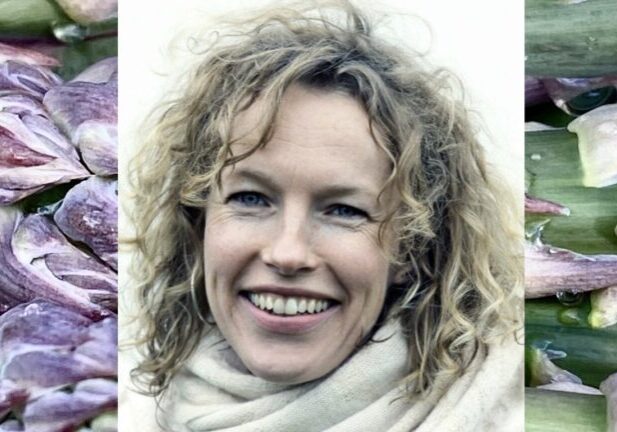
 Renée Toft Simonsen
born 1965 is a mother of four, psychologist and author. Through the turbulence that fame always creates, she has managed to maintain her insistence on deep human and artistic values in a way that makes an entire nation embrace her with warmth and respect. Her latest book titles include the autobiography Renée – Finding Home and I'm f*cking hot – A journey through the inland landscape around the age of 50.