

BLOGCAST: The post is recorded by Hanne Linde. Listen to the blog here (04:54)
Indigenous peoples have always known this:
There must be a balance between what we give and what we take.
How are we as humans equipped by nature to create this balance?
Among other things, through our innate abilities to act with both open and focused awareness, with warmth (empathy and compassion), with creativity, and with physical and spiritual presence. These abilities contain an inherent knowledge of coherence, which slowly, at the beginning of life, is competed with by an equally amazing inherent ability to differentiate and separate, which gains momentum as the self is formed in the early years.
Between these two abilities there must be a balance in the individual. Between our contact with and rest in the inner resources and our outward realization of the many possibilities that the development of our self offers. A balance between our being in unity and community and our realization of our individual possibilities.
In the Western world, there has long been an imbalance in favor of external action and the ego's urge to manifest its enormous resources and creative development potential in the external world.
This has led to overconsumption of both nature's and our own human resources and an increasing alienation of the individual from himself and his own essence, and thus also from other people. What one does not sense and can feel in oneself, one cannot recognize in others.
In Children's Life Science we work to re-establish this connection for children and adults in the education system. We begin by creating connection for the individual professional internally with meditative exercises that are based on strengthening contact with the natural, innate competencies. This work is combined with relational work that aims to make the individual aware of where there are elements in their personality that make direct contact with both themselves and others difficult.
Our experience is that if the improved contact with the inner qualities is to manifest in everyday life, it is also necessary to work relationally with the factors in the personality that can hinder the constructive contact with others. The relational work is thus crucial so that the fruits that can possibly be harvested from the work with the inner, meditative exercises can also manifest in the daily work in relation to children, parents and colleagues.
This work also has an impact on the possibility of changing and developing the fundamental values in the organization, as a more constructive relational approach promotes the possibility of also dealing with content and value changes more constructively.
In this way, we work specifically with the school's ability to create a balance in the individual actor - child and adult - in order to form the best possible basis for creating a learning and educational environment that benefits as many people as possible.
The individual and their daily relationships are embedded in different systems. Social, institutional, habitual. Schools, forms of education and social interaction. These systems are not always developed today to meet the need for balance between the inner and the outer, because they were mostly created in a time when humans seemed to have had unimaginable opportunities to take without having to create balance by giving back, either to nature as a whole or to the individual.
To create the necessary balance between internal and external, it is therefore best for a given school to work with the entire system, not just the entire school and the parents. This form of work, which also takes into account the system in which the school is embedded, is called whole school approach.
This strategy, which focuses on both internal and external sustainability and balance, is supported by the paradigm shift in psychology and pedagogy that shows that the time has come to completely abandon the pedagogy of industrial society based on obedience and discipline. To replace it with a starting point that, through recognition, empathy and presence, provides the opportunity to develop a balanced personal authority and authenticity in both children and adults.
The article first appeared in Children's Life Skills direction.
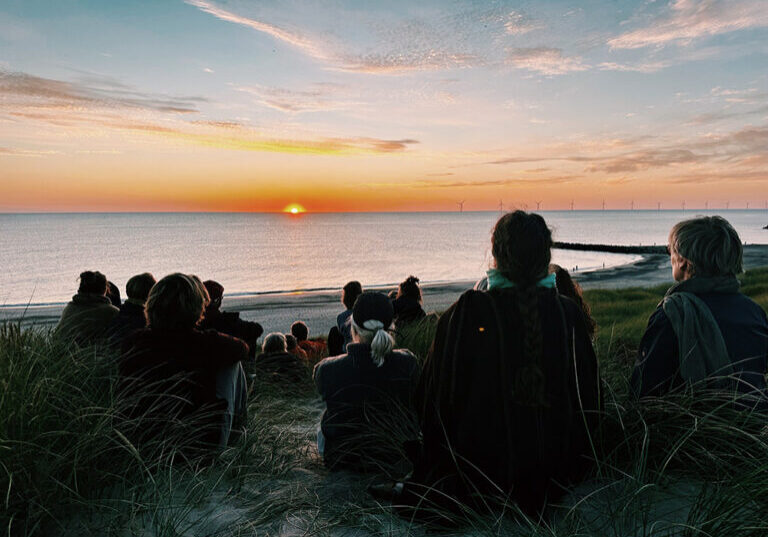
Photo: Katherine Hanlon/Unsplash
 Helen Jensen
MSc in Psychology, specialist and supervisor in psychotherapy.
Co-founder of the Association for Children's Life Skills. Together with Jesper Juul, she has taught relationship skills and family therapy in a number of European countries and is the author of several books on presence and relationship skills. For the past 15 years, a large part of her work has been centered on connecting work with relationships with exercises anchored in the pentagon. For example, in various projects that have been accompanied by research. She is also primarily responsible for and teaches the 2-year international education “Training Empathy”.
Publications include: Pedagogical relationship competence. From obedience to responsibility (2002, with Jesper Juul), Presence and empathy in school (2014) and Empathy – what holds the world together (2012, with Jes Bertelsen, Jesper Juul, Michael Stubberup, Peter Høeg and Steen Hildebrandt).
Research projects; The Relationship Competence Project at the Teacher Training College in Aarhus. EU – Erasmus plus the project Hand-in-Hand, on the development of socio-emotional-intercultural competences, and a 5-year development and research project in Berlin, Empathy Makes Schools.