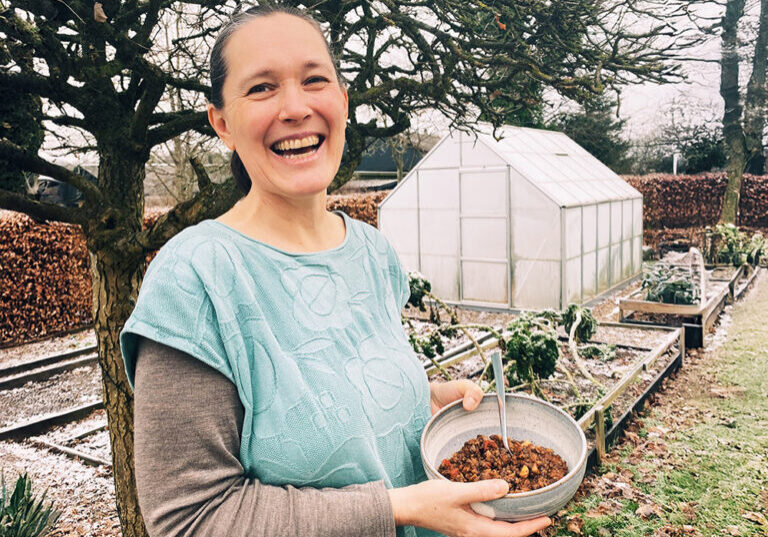
Gitte Batz's years of experience with children, warmth and presence
of | Relationship competence | February 25, 2017

Fifth newsletter for the education in empathy and presence.
We have now held the sixth module in our training course. This time, teacher Gitte Batz taught how to support children in establishing and maintaining a good space for themselves and others.
Gitte has many years of experience in working with empathy and presence in relation to children. She has participated in Children's Life Skills collaboration with the Teacher Training Institute in Aarhus from the beginning of this collaboration. And she has taught with Helle Jensen and Katinka Gøtzsche.

In addition to being a teacher, Gitte has a degree in motor skills guidance. Her work with young children in particular is often based on the body. This Monday was an alternation between her short, concentrated presentations and her instruction in exercises she does with the children.
If I were to summarize some of today's many angles on working with empathy and presence, it could go like this:
Gitte began and ended by emphasizing the importance of the teacher and educator being grounded in themselves. That they have a regular practice of their own. That it is this inner anchoring that gives the adult the natural authority that makes the children open up to this presence and empathy training.
We then watched a few moving film clips of children around the age of ten giving each other a physical treatment. Half of the children are sitting on chairs, the others are standing behind them. The whole atmosphere, the teacher's instructions and the children's attentive listening naturalness as they give each other massages following the simple instructions that they clearly know, is calm, immersive and uncomplicated.
Gitte talked about the importance of patience in this work. Children need time to get used to this mutual touch, to discover the joy of feeling inwardly.
And the joy of stepping forward. One of the exercises we tried was to stand in a circle, think of an experience from the past weekend, and then step forward, one at a time, and tell this experience to the others.
In this exercise, the children get used to calmly remembering backwards and finding a situation they want to tell, they get used to listening to others, and they themselves receive, from the group, the responsiveness that makes you feel welcomed.
Gitte spoke about the value that can be had in introducing children from the younger grades to such a way of working. This is then carried forward and can form part of a foundation for, from the age of ten onwards, beginning to encounter the greater forces that are part of their maturation.

Gitte said that with just a few minutes of introspective work in the form of small meditations or touch exercises like the aforementioned, you can establish a calm and friendliness in the room that makes academic learning processes both easier and more enjoyable.
She showed film clips with children in which they, touchingly, talk about the joy of exercises like these.
She also talked about the collaboration with colleagues. How it is possible for a teacher or educator who has truly mastered this way of working to visit other classes or to 'exchange' classes and thereby inspire colleagues and children (one of the questions we, as those responsible for this process, frequently encounter from school principals is: How is it possible for one or a few employees who have completed such training to inspire and raise the professional level in this area among colleagues?
Gitte argues that this is possible. And that the work with mutual inspiration can in itself give an extra dimension to the collegial collaboration.)

The day also included a number of 'tricks' or tool ideas: Gitte brought a pink suitcase filled with medicine balls, small toys and other gadgets that can be used in the following way: She has the children lie on their stomachs (so that the front of the body is 'protected' from the floor), and then has the children who are giving the treatment choose from the suitcase and use balls or toys to gently massage and touch the backs of the lying children.
The suitcase and objects add a colorful and creative element to the situation and make it easier to introduce this form of contact that is unfamiliar to the children.
For many of the exercises, Gitte uses music. She explained how music establishes an aural spatiality that supports the children's inner and shared space.

This Monday it was as if the children were present, in Gitte's communication and because we are now well into the process of teaching each other and sharing concrete teaching experiences.
I find that it is clear to all of us that the common foundation we have established over the past six months now enables a very fast, precise and creative sharing of experiences. We see Gitte's exercises, immediately understand their pedagogical idea, and can immediately feel our own inventiveness starting up as a stream of images of how we would use these exercises for our class or for our courses.
We are a place where we can pour out to each other, learn from each other, steal from each other with permission from everyone for this creative theft.
Heartfelt thanks to Gitte for scooping up so much valuable stuff worth stealing!
Photo: Jeanette Lykkegård
 Peter Hoeg is a master of arts, author and teacher of meditation, empathy and creativity. He is co-founder of Børns Livskunskab and leader of the association's course in relationship skills. Peter lives in connection with Vækstcenteret in Nørre Snede, and is in training with Jes Bertelsen.
Photo: Henrik Saxgren