Per Olov Enquist died on April 25, 2020.
Listen to Peter Høeg read his text about the Swedish author.
Enquist is dead.
But his consciousness is completely open and accessible.
Don't worry, this is not meant to be occult or spiritualistic. You can't talk to Enquist anymore.
But one can encounter the creative part of his consciousness. When a person has written as he has, with such great openness towards the source from which the inventiveness flows, then the person's works are more than just displays of something that once was. Then they are entrances to something deeper, something that is experienced as if it will not disappear.
With Enquist's books, I can remember where I was when I first opened them and read the first lines: From the life of earthworms, the play about HC Andersen, I read standing at the drama shelf at Copenhagen Main Library. An hour earlier, on the bus, I had met Poul Lier, French teacher and mentor at Vestre Borgerdyd Gymnasium for Villy Sørensen, Klaus Rifbjerg, Niels Barfoed and Peter Brask. He had taken my arm in an iron grip and whispered: -Have you read Enquist, From the life of earthworms, you should hurry up and then see Jørgen Reenberg as HC Andersen at the Royal Theatre, but first you should read the text!
I went straight into the Main Library, which was then located on Kultorvet, and opened the book, started reading, and came to my senses three quarters of an hour later, having read the entire text.
I read The musicians' excerpt in the garden of a farm property on the dammed Lammefjord area. To this day I can see the cover as if I were holding the book in my hand.
I read the first lines of Captain Nemo's Library standing at a desk at the Copenhagen Police passport office in Store Kongensgade. The Swedish bookstore was down the street, and I had just picked up the book after having pre-ordered it for six months, and now I couldn't wait, but opened it and read:
’'Now, soon, my benefactor Captain Nemo will open the water tanks so that the vessel with its library can sink into the sea.
I've gone through the library, but not everything. I once thought it was possible to go through everything. Even though it would have been against my better judgment.
Although courage knowing better is a good way not to give up. If we knew better, we would give up.'’
I read The Legionnaires sitting on a bench at Sortedams Dosseringen without knowing that Enquist lived right behind me. I read the play In the hour of the lion In one fell swoop, sitting in an empty office at my publishing house, Rosinante, Johannes Ries had gotten me the manuscript before the play was printed.
Now, as I write this and remember all these situations that I mention – and many more that I don't mention – I can feel the massive gratitude towards Per Olov Enquist in my heart. Like a wealth. And a pressure.
Gratitude must be expressed. Fortunately, I managed, once I managed to say it to him.
I met Enquist three times. One unsuccessful time, one successful one, and then the last and decisive one.
The first time was at the Gothenburg book fair in 1989. My first book had come out in Swedish, at Norstedts, the publisher gave a reception and suddenly I was sitting next to Enquist.
In front of him he had two very large draft beers. Not one, but two. He looked at the completely unknown young Danish author and asked if I would sign a book for him.
I did. When he left a little later, he forgot my book, it was left on the table where he had been sitting.
That gave me some food for thought.
The first thing I thought was that if I ever found myself in the situation of meeting an author who was younger and more unknown than me, I would try to be careful.
The second thing I thought was how difficult it is in life to make things fit together. If we experience great art, we also want the person to be great. That the artist's ordinary personality should be extraordinary.
The second time went better. Hanser Verlag is both Enquist's and my German publisher, and there the director Michael Krüger, one of the very big elephants of the international publishing world, had the idea to pay tribute to the brilliant visual artist and book illustrator, Quint Buchholtz, by having some twenty authors each write their own text for their own picture. Enquist and I, partly by chance, met at the same time, in Munich, with Krüger to be presented with our picture.
Krüger had a Luciferian gleam in his eye as he gave us the assignments. He is a man who likes to be on his toes. The picture for me was of a kind of seesaw on which some stones balanced a stack of books. Krüger knew that I did not, then as now, care about the way literary reviews measure and weigh books. And that I would now have to address this discomfort in writing.
Then he turned to Enquist. And handed him a black-and-white drawing. It depicted a typewriter half hidden behind a stage curtain, as if hidden out of the way. In front of the curtain, on the stage, stood a writer, writhing awkwardly in front of an audience. The writer bore a suspicious resemblance to Enquist.
That evening we went out to dinner with Krüger. Enquist and I sat next to each other.
– Enquist, I said, may I ask something, with regard to Quint's drawing for you, what is it that the author would most like from his audience?
At first I didn't think he would answer. His hands were shaking as he poured. He saw that I saw it, and stared me straight in the eyes.
– It's my carafe arthritis, he said.
I nodded.
– Love, he said. – That's love we want from the audience. The less we've gotten of it at home, the more we want. It's a sore spot, it's a black hole, it can never be filled.
It wasn't said in a friendly way, it was more like a snarl. But it was completely sincere. For maybe ten seconds, there at the table, we really connected.
Norstedts published a celebratory publication for Enquist, I think it was on the occasion of his 70th birthday. It was simply titled PO.
Festival writings are a dangerous genre.
For me, it was a slightly jarring read. The book was filled with respect. With homage. With admiration. But it was almost devoid of warmth. Considering that it was for an author who had written so incomprehensibly beautifully and vulnerablely and sensitively about love, it was astonishing that this circle of contributors in this situation had so little warmth to express.
In 2017 I was in Stockholm, where my last meeting with Enquist took place. The decisive thing.
A new book of mine had come out in Swedish, Norstedt had asked me to hold an evening at the Kulturhuset in Stockholm, and Enquist and his wife, Gunilla, came to that evening.
They were sitting right up on the stage, Enquist looked pretty fresh. Yet I got the feeling that this was the last time I would see him. That if there was anything that needed to be said, it was now.
I thanked him from the stage. For everything he had meant to me.
It felt so good that there were witnesses, the room was packed, there must have been at least 500 people, in front of them I told them that I had written my first books against role models, that is, consciously imitating, not copying, but imitating, to try to share in the creative power that lay behind the writings I admired. And one of those I had most intensely tried to learn from was Enquist.
Imitation is the best way to learn, and we writers are sometimes afraid to understand and then admit it. Peter Bastian once told me that he felt that writers limited themselves unnecessarily by avoiding imitation. – Musicians have understood this, he said, – when I improvise, I might first play a phrase I take from Coltrane, then a phrase from Gillespie. And then suddenly I hear myself playing something third that I haven’t heard before.
That's what I thanked Enquist for there on stage in Stockholm. For having written so many deep and miraculously different and intense works that they can awaken our creativity and make us want to imitate and learn, to perhaps take a small step towards the extreme, and extremely original, creativity that flowed through him.
There was a party afterwards, organized by Norstedts, on the board they have a woman who is not only a major publisher, but who also lives in what must be Scandinavia's largest and most expensive private residence if we exclude the royal castles.
It was a palace facing the water, very close to central Stockholm, with waiters and cooks, and on the walls Renaissance and 18th-century paintings of a size and quality that you would normally only see in Europe's great art museums.
I still needed to say something to Enquist. So, partway through the dinner, I got up and walked over to him.
Up close, I could suddenly feel how close he was to death. He, who otherwise had this tall, strong, bony body in which you could feel the reflexes of athletics and the Swedish high jump championships, was now as frail as a bird.
I squatted down, it was the only way to establish some kind of intimate space, and it felt good to sit like that, in a way a little at his feet.
– I'm missing one more thing, I said. -to thank you for the compassion for the people in your books. And for something that feels as if it can't be said.
I could feel we had a connection. Normally he would have started saying something to cover up his feelings, but now he just stared at me.
I stood up. To end the situation, to walk away from the shyness.
Then I heard myself say something that to this day I don't know where it came from.
– Enquist, I said, – when you have created a language cathedral like yours, a literary world in itself, what about the danger of being locked up in your own writing, what about the risk of the loneliness of self-absorption?
The question must have given us both a little shock. The situation kind of froze.
We looked into each other's eyes. For a moment it was like we were the only people in the room.
– If now, he said slowly, slowly and quietly, – if now you feel that books are the only thing you have done reasonably well.
The age difference was gone, the reservations were gone, the veils that separate people were gone, for a very brief moment there was like a nudity, the same nudity as in his books. But now it was in reality.
Then I hugged him. It was a boundary-breaking act, it was the first and last time we touched each other, apart from shaking hands, I'm not one to hug people I don't know well, Enquist even less so. But at that moment we hugged each other.
And then it was over.
Now he is gone.
But the books are there. They are portals into a mighty universe.
Photo courtesy of Norstedts Publishing House: Magnus Liam Karlsson
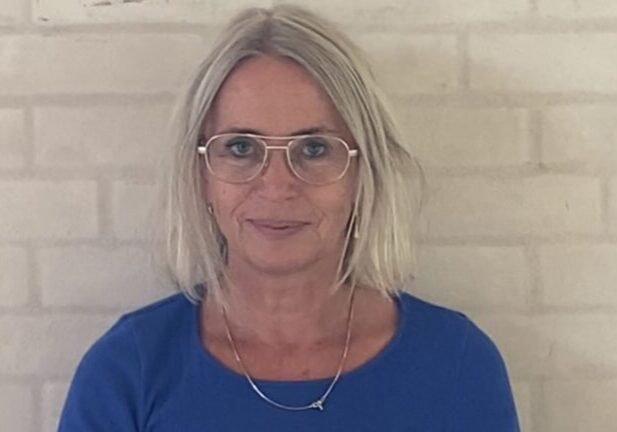
 Peter Hoeg is an M.A., author and teacher of meditation and creativity. He is one of Kontemplation's regular teachers, co-founder of the Children's Life Knowledge Association and part of the Growth Center's teaching group.
Peter lives in connection with the Growth Center in Nørre Snede and receives practical guidance from Jes Bertelsen.
Photo: Henrik Saxgren