



LANGUAGE, BREATH AND PRESENCE
Meditation and creativity with
audio file · 17 minutes
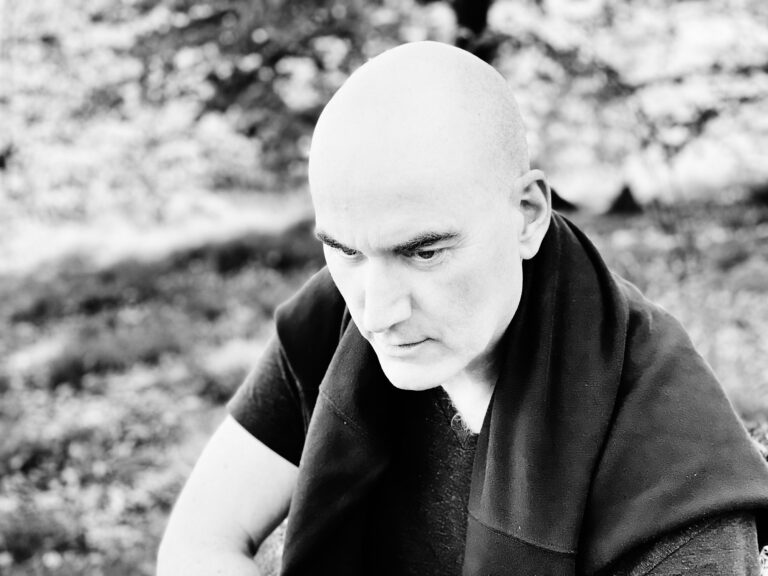
In this meditation, which is the second and final part of two, Martin begins by establishing bodily calm and presence around breathing. (You can find the first part here: A meditative study.)
Then word pairs are introduced again, one word for the inhalation and one for the exhalation.
These are the words the study applies to.
The guidance is so inviting and open that it is possible to turn the investigation in several directions:
Words have both an expression and a content, a sound and a meaning.
You will be able to immerse yourself in the sound and almost taste it.
And you can work with the meaning in several ways:
One option is to allow free associations. You allow the word, for example 'to receive' and 'to give' which is a word pair Martin suggests in this meditation, to give off images. First perhaps images from your life, experiences of significant (or anonymous) situations where you have received or given. Then you let the associations expand, to events you have heard or read about, perhaps to mythological give-and-receive situations.
Jung calls this approach amplification, expansion, and he writes that it can bring us onto the trail of the extensive networks of associative connections that lie in the unconscious - both in our own and the collective unconscious.
When we, as in this meditation, connect our presence around the meaning of words, their semantics, with the breath, we have the opportunity to experience how closely the body and language are connected: Perhaps we choose, to now take another pair of words that Martin suggests, love and compassion, to examine which aspects of love can be connected to the breath. Do we perhaps recall that in the ecstasy of love we have gasped for breath? Or inhaling the scent of our love partner? Perhaps even wanting to completely inhale another person in order to physically absorb that person?
And do we notice, when we examine the word compassion in connection with the exhalation, how the experience of compassion will often give birth to a desire for outward action? For an expression?
By turning this meditation in a creative-associative direction in this way, we approach the experience of what is called the embodied mind, the science of the connection between body and consciousness as formulated by, for example, the Chilean Francisco Varela, a science that examines how our perception is closely connected to our sensory apparatus and nervous system, which in turn is woven into processes with our surroundings. A theory that Varela has taken even further to the discipline called enactivism and which attempts to describe the complicated interaction between consciousness and the outside world.
Varela was strongly inspired by Dzogchen, which is also Martin's training background.
We therefore allow ourselves to end with a slightly longer quote that conveys some of Varela's love for humanity:
’'If everyone could agree that the reality they believe they live in is one possible reality, and that what we humans actually have in common is our capacity to construct a reality for ourselves, then perhaps we could come together in the effort to construct an overall worldview that could ensure survival and a dignified life for all living beings on the planet – instead of as now where we in different groupings are locked into our own particular way of approaching things.'’